The Real ROI of a Channel-Letter 3D Printer: What Each Letter Actually Costs to Make
Published Updated
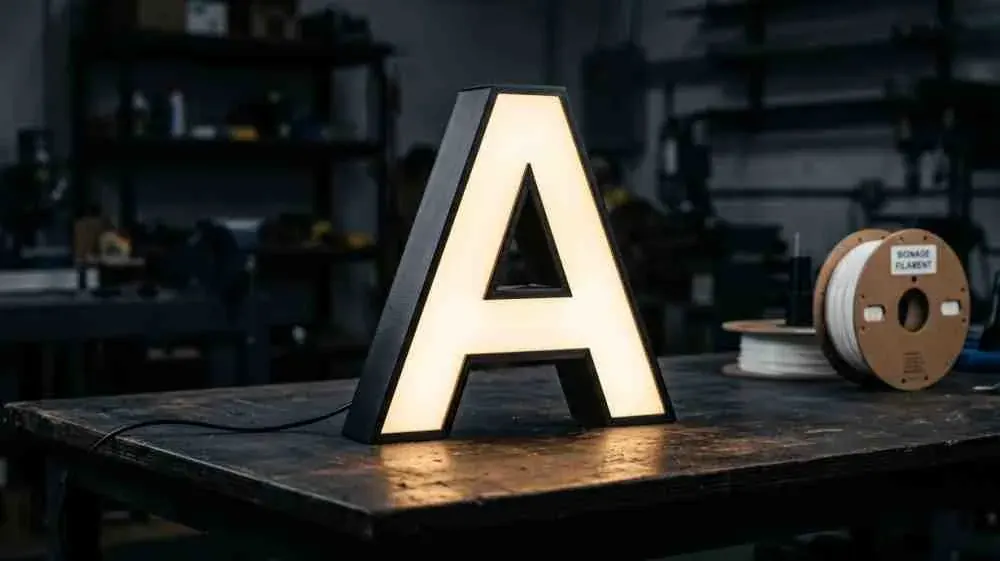
If you make signs for a living, the decision to bring a channel-letter 3D printer in-house comes down to one question: how quickly does it pay for itself? Not the spec sheet, not the marketing – the maths.
So let’s do the maths, with real numbers. Below you’ll find what a 3D-printed channel letter actually costs to produce, how that compares with traditional fabrication, and a simple payback model you can adjust to your own shop. Everything is in pounds, based on 2026 UK figures.
How channel letters are costed today
Traditional channel letters are built the way they have been for decades: aluminium returns bent and welded by hand, acrylic faces cut and formed, trim caps fitted, LEDs wired in, and the whole thing assembled by a skilled fabricator. The materials matter, but the dominant cost is skilled labour – and labour scales with complexity.
This is why a “price per letter” never quite holds up. A simple capital “I” needs minimal forming. A looping script “S” in a fine font can take hours of careful hand-work to bend and assemble. The more characters, the more curves, the more your labour bill climbs.
A 3D printer doesn’t care. It prints a complex script letter using exactly the same automated process as a plain block letter – and it does it overnight, unattended. That single difference is where most of the return comes from.
What a 3D-printed channel letter actually costs to produce
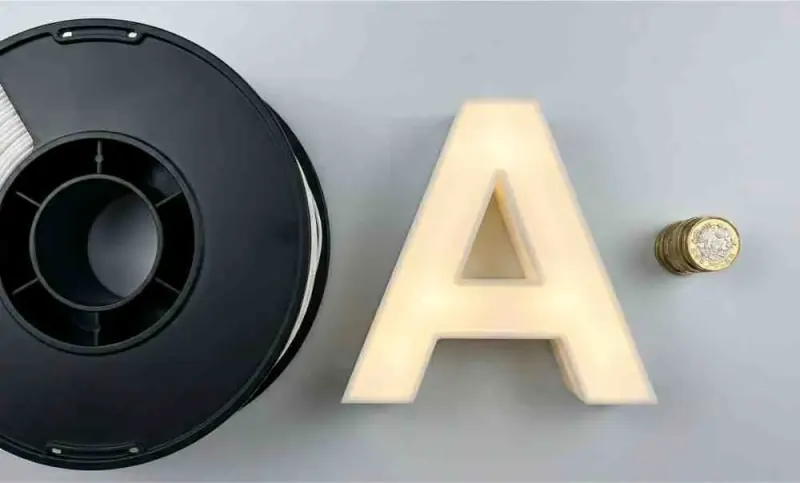
Let’s take a typical letter: 30 × 40 × 5 cm, printed on an SG machine in HFPC, our purpose-made signage filament.
Filament. A 1 kg spool (around 400 m) of HFPC costs £20.99. A letter that size uses roughly 60–70 m of filament. That works out at:
£3.15 to £3.70 of material per letter.
Electricity. This is where 3D-printed signage genuinely surprises people. An SG machine draws only 1-2 kWh for a full 24 hours of printing. With UK business electricity at around 26-28p per kWh in 2026, running the machine flat-out for a whole day costs:
roughly 27p to 54p – less than a cup of coffee.
Spread across the letters that come off the bed in that time, the electricity per letter is a matter of pennies – call it 1-5p.
Labour. Because the machine is fully automated and runs unattended, there is effectively no hands-on labour during printing. One operator can keep an eye on up to ten machines at once, so the labour you can fairly attribute to each printed letter is close to zero. Your skilled time goes into finishing and installation, not standing at a workbench bending metal.
Finishing and lighting. This is the part that varies by sign. Depending on whether you print the face or use an acrylic face, the LED modules and power supply you choose, and your paint/finish, you’ll add some bought-in cost and a little finishing labour per letter.
Cost to produce one finished letter (illustrative)
| Cost line | Per letter |
|---|---|
| HFPC filament (60-70 m of a 400 m / £20.99 spool) | £3.15 – £3.70 |
| Electricity | ~£0.01 – £0.05 |
| Print labour (automated, unattended) | ~£0.00 |
| LED modules, face, finishing & share of finishing labour (your figure) | e.g. £20.00 |
| Approx. total to produce a finished, lit letter | ~£23 – £24 |
The two numbers that are genuinely yours – filament and electricity – are tiny and fixed. The finishing line is the one you control, and it’s the same finishing you’d do on a fabricated letter anyway.
3D printing vs traditional fabrication, side by side
| 3D-printed (SG) | Traditional fabrication | |
|---|---|---|
| Material per letter | ~£3.15 – £3.70 (HFPC) | Aluminium returns + acrylic face + trim cap |
| Skilled labour | Near-zero – automated, unattended | Significant – bend, cut, form, weld, assemble |
| Effect of letter complexity | None – any shape prints the same way | High – script and fine detail take far more hours |
| Throughput | 24/7 unattended; one operator runs several machines | Limited by available skilled-labour hours |
| Energy to run | ~27-54p per 24 hours of printing | Compressors, tools, etc. |
| Consistency | Identical every time | Depends on the fabricator on the day |
We’ve deliberately not put a single pound figure on the traditional column, because it swings wildly with letter size, complexity and your local labour rates. But the shape of it is clear: traditional cost is dominated by hours of skilled work, and 3D printing converts most of those hours into machine time you don’t pay by the hour.
Your payback period
Here’s the part that matters. Payback is simply:
Machine price ÷ gross profit per letter ÷ letters produced per month = months to break even.
An SG channel-letter printer ranges from £3,900 for the entry SG-S 3D Ultra 80×80cm to £8,800 for the top-of-range SG-S L2S Pro 120×120cm.
Example assumptions (illustrative – set your own):
- Selling price per finished, lit letter: £90
- Cost to produce that letter: £25 (≈ £3.50 filament + electricity, plus ~£21.50 lighting, face and finishing)
- Gross profit per letter: £65
At that margin, here’s how quickly each machine pays for itself at different production volumes:
| Letters / month | Monthly gross profit | Payback – £3,900 machine | Payback – £8,800 machine |
|---|---|---|---|
| 10 | £650 | ~6.0 months | ~13.5 months |
| 20 | £1,300 | ~3.0 months | ~6.8 months |
| 30 | £1,950 | ~2.0 months | ~4.5 months |
| 50 | £3,250 | ~1.2 months | ~2.7 months |
To put volume in context, a single storefront sign is often 8–15 letters, so 20–30 letters a month is just two or three jobs. On those numbers, the entry machine typically pays for itself in two to three months – and that’s before you factor in the full-sign revenue (design, power supply, wiring and installation) that layers margin on top of the per-letter figure.
Change the selling price or the volume and the table moves, but the conclusion rarely does: at the material and labour costs above, a channel-letter 3D printer is one of the faster-paying pieces of kit a sign shop can buy.
Payback calculator
Work out your own payback.
Put in your own figures. Nothing you type here is sent anywhere.
- Monthly saving
- £1,872
- Payback
- –
Enter the machine price you were quoted to see the payback.
Monthly saving = letters × (cost bought in − filament cost). Payback = machine price ÷ monthly saving. The starting figures are examples: about £97 is a typical UK trade price for a 500 mm face-lit letter (checked 25 September 2026), and £3.40 is the filament for one letter in the worked example below. Filament only: if the letters you buy in come with faces and lighting, add what those cost you to the filament figure.
A worked example: a 12-letter shopfront sign
Say a retail client wants a 12-letter illuminated shopfront sign, letters around 30-40 cm tall.
- Filament for all 12 letters: roughly 12 × £3.40 ≈ £41 of HFPC.
- Electricity to print them: the letters print over a day or two of unattended running – well under £1 of power in total.
- Finishing and lighting: your LED modules, power supply, faces, paint and finishing labour on top – the same work you’d do on any sign.
A complete, professionally installed storefront sign of this kind typically sells in the region of several thousand pounds. The core letters that the sign is built around cost you about £41 in filament and under £1 in electricity to produce. Even after lighting, finishing and installation, the production cost of the dimensional letters themselves – the part that used to soak up hours of skilled fabrication – is now a small, fixed, predictable number. That gap is the return, repeated on every job. (Selling prices vary by size, complexity, lighting and region; figures are illustrative.)
Where 3D printing wins – and where to be realistic
It’s not magic, and we’d rather be straight with you. Very large formats, certain face treatments and complex multi-layer builds still need thought, and you’ll still spend time on finishing, wiring and installation. If your work is overwhelmingly one-off giant letters, the calculation is different.
But for the bread-and-butter of most sign shops – illuminated channel letters and logos for retail, hospitality and offices – the economics are hard to argue with. You collapse the skilled-labour cost, you remove the complexity penalty, and you can produce overnight without adding staff. For durability and finish concerns, our guide to the 12 most common channel-letter issues covers what HFPC and a good workflow handle.
The bigger picture beyond per-letter cost
Three things compound the return over time:
- Lights-out production. The machine runs 24/7 unattended, so your capacity isn’t capped by your working hours.
- One operator, many machines. Add a second or third printer and your labour barely changes – you scale output, not headcount.
- Running costs that stay low. At under £1 a day in electricity, the machine’s ongoing cost is almost a rounding error against the work it produces.
And because every SG printer is assembled in the UK, comes with on-site training, locally stocked spare parts and a 2-year warranty, you’re not gambling on overseas support to keep production moving..
Frequently asked questions
How much does it cost to 3D print a channel letter? For a 30 × 40 × 5 cm letter, the filament costs roughly £3.15-£3.70 (60-70 m of a £20.99 spool) and the electricity is a few pence. With LED modules, face and finishing, a complete lit letter typically lands in the low-£20s – versus the much higher cost of hand-fabrication once skilled labour is included.
Is 3D printing cheaper than traditional channel-letter fabrication? For most standard illuminated letters, yes – because it removes the skilled-labour hours that dominate traditional fabrication, and it doesn’t charge a “complexity penalty” for script or detailed fonts.
How long does it take to pay back the machine? On illustrative figures (a £65 gross profit per letter), the entry £3,900 machine pays for itself in around two to three months at 20–30 letters a month – roughly two or three storefront signs. Use your own selling price and volumes to get an exact figure.
Are 3D-printed letters good enough for outdoor signage? Yes. HFPC is engineered for outdoor illuminated signage, with strong light diffusion and weather resistance. See our guide to common channel-letter issues for the detail on durability and finish.
See the numbers for your shop
Want a payback figure based on your actual selling prices and volumes? Request pricing and a personalised ROI estimate and we’ll run it with you. You can also explore flexible finance and leasing to spread the cost, or read our practical dossier on 3D-printed channel letters for the full production picture.
ROI figures in this article are illustrative and provided to help you model your own numbers; they are not a guarantee of results. Finance and tax treatment vary – confirm your position with a qualified accountant.