3D-Printed Signage for Retail & Shopfronts: A Sign-Maker’s Guide
Published Updated
Shopfront signage is the bread-and-butter of most sign businesses – and it’s where first impressions are won or lost for the retailer. A sharp, well-lit storefront sign pulls people in; a tired or generic one is ignored. For sign makers, 3D printing has quietly changed what you can offer high-street clients, how quickly you can deliver it, and how much margin you keep. Here’s a practical guide to producing retail and shopfront signage with a 3D printer.
What retail clients want from shopfront signage
Before the production method, it helps to remember what a retail client is actually buying:
- Kerb appeal. A sign that stands out on a busy high street and looks premium up close.
- Brand accuracy. Letters, logos, colours and fonts that match their identity exactly.
- Illumination. Most retailers want their sign to work as hard at night as it does by day.
- Durability. It has to survive years of British weather without fading or failing.
- Speed. Fit-outs run to tight deadlines; a sign that holds up the opening is a problem.
- Value. A finish that looks high-end without a fabrication price tag to match.
3D-printed channel letters tick all of these – and the production advantages let you deliver them more profitably than traditional fabrication.
Why 3D printing suits retail signage
Retail storefronts are a near-perfect fit for 3D-printed channel letters:
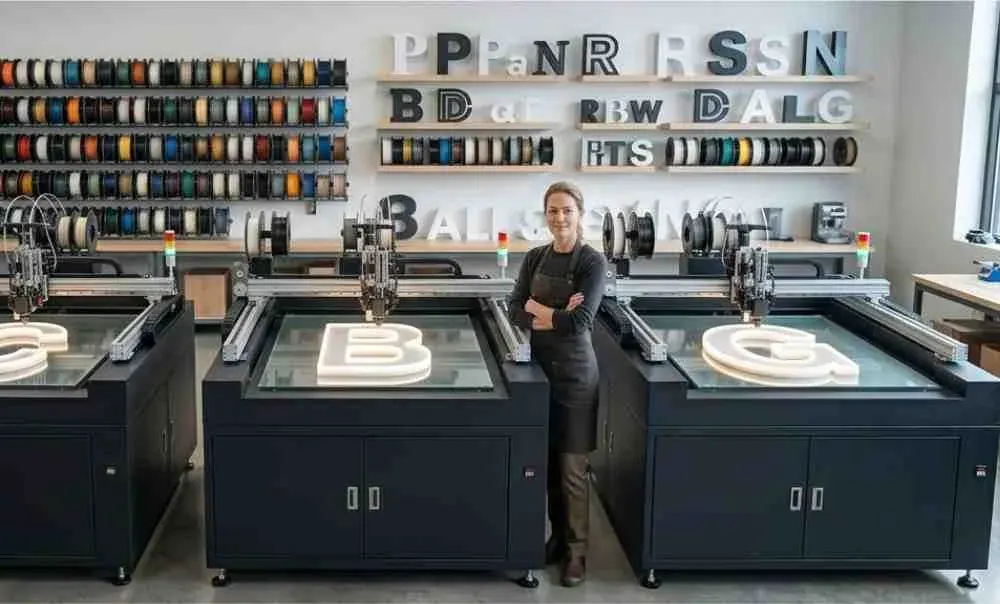
- Multi-letter signs, produced overnight. A shopfront is often a whole word or two – 8 to 15 letters. A 3D printer produces a full set unattended, overnight, so you’re not waiting on a fabricator’s queue.
- No complexity penalty. Whether the shop name is a plain sans-serif or a looping script logo, the machine prints it the same way. Traditional fabrication charges for every awkward curve in hand-labour; 3D printing doesn’t.
- Consistency. Every letter comes out identical and on-brand, every time.
- Low material cost. A typical letter uses around £3.15–£3.70 of filament, so the core of the sign costs a few pounds to produce.
- Control. With production in your own workshop, a last-minute size or colour change is your call, not a back-and-forth with a supplier.
The signage types you can produce
3D printing lets you offer a full range of dimensional and illuminated shopfront signage:
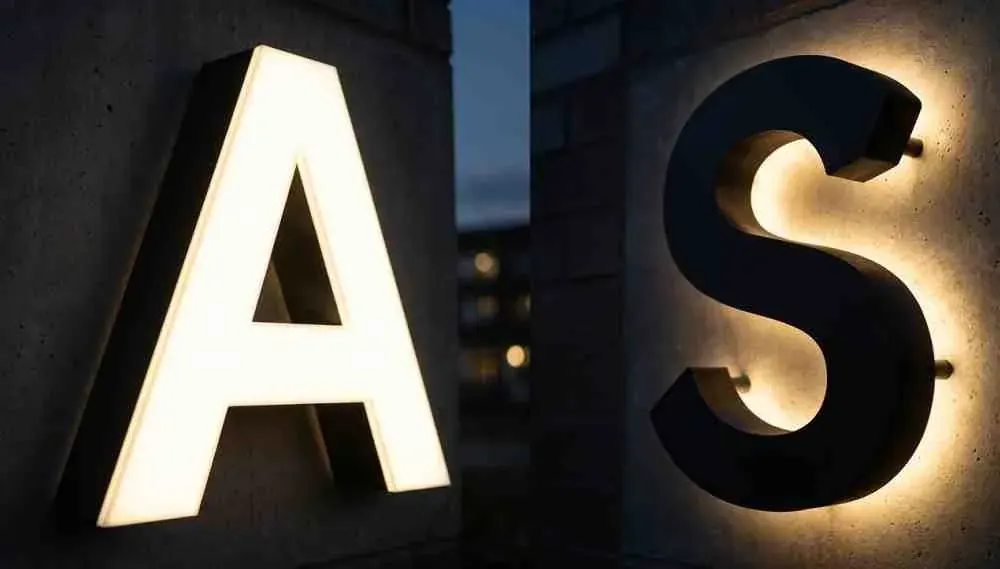
- Front-lit channel letters – the high-street classic: bold, bright letters lit through the face.
- Halo-lit (back-lit) letters – light washes the wall behind the letters for an elegant, premium glow that looks superb at night.
- Side-lit letters – light emerges from the returns for a distinctive contemporary look.
- RGB / colour-changing signs – programmable colour for brands that want something dynamic.
- Infinity-mirror letters – a layered-depth lighting effect with serious wow factor.
- Fascia logos and dimensional lettering – three-dimensional brand marks and lettering that lift a storefront beyond flat printed signage.
For more inspiration on what to offer high-street clients, see our post on creative signage ideas for UK sign companies.
Lighting options for the high street
Lighting is what turns a nice set of letters into a sign that sells.
The two most popular retail choices are front-lit letters, for maximum daytime and night-time punch, and halo-lit letters, for a more refined, upmarket glow.
Many premium retail brands favour halo lighting precisely because it reads as high-end.
Whatever the effect, the goal is even illumination – no bright hotspots or dark patches that cheapen the look. HFPC’s light-diffusing properties help spread the light smoothly, and sensible LED placement does the rest.
Built for the British high street
A shopfront sign lives outdoors, exposed to rain, sun and temperature swings, often for years. HFPC is engineered for exactly this – purpose-made for outdoor illuminated signage with weather and UV resistance – so your retail signs keep looking sharp long after installation.
Getting the durability right comes down to the right material and a sound build; our guide to the 12 most common channel-letter issues covers the finishing and weatherproofing detail.
Turnaround: winning retail rollouts
Speed is a genuine competitive edge in retail signage. Because you produce overnight and unattended, you can commit to tight fit-out deadlines with confidence – and win work that shops with slower supply chains have to turn away.
It also makes you a strong fit for multi-site retail rollouts, where a chain needs consistent signage across many locations to the same standard and timeline. Producing in-house means you control both.
The margin opportunity for your shop
Here’s the part that matters commercially. When the core letters of a storefront sign cost a few pounds of filament and pennies of electricity to produce, and you’re no longer paying a fabricator’s mark-up, the margin on retail signage improves significantly – and you keep it.
A typical storefront sign sells for a healthy figure once design, lighting, power and installation are included; the production cost of the dimensional letters is now a small, predictable line.
Our ROI breakdown and our guide to bringing production in-house show the numbers in full.
Getting started
Adding 3D-printed shopfront signage to your services is more straightforward than it sounds.
An SG-S 3D Ultra handles the great majority of retail letter work, the machines run with simple one-button operation, and on-site UK training gets your team producing quickly.
To understand the production process step by step, see our workflow guide; for budgets, our price guide lays out the costs.
Frequently asked questions
What is the best type of illuminated sign for a shopfront? Front-lit channel letters offer the boldest day-and-night impact, while halo-lit (back-lit) letters give a more premium, understated glow that many upmarket retailers prefer. Both are easily produced with a 3D printer.
Are 3D-printed shopfront signs weatherproof? Yes. HFPC is purpose-made for outdoor illuminated signage, with weather and UV resistance suited to the British high street, provided the sign is built and finished correctly.
How quickly can a shopfront sign be made? Because letters print unattended, a full storefront set typically runs overnight – which makes 3D printing well suited to tight retail fit-out deadlines and multi-site rollouts.
Is 3D-printed signage cheaper than traditional fabrication for retail? For most shopfront work, yes. The material cost is a few pounds per letter and there’s no complexity penalty for detailed logos, so producing in-house improves your margins compared with outsourcing to a fabricator.
Add shopfront signage to your services
Want to offer faster, more profitable retail and shopfront signage? Get in touch or book a demo and we’ll show you what a channel-letter 3D printer can do for your storefront work. To run the numbers first, start with our ROI breakdown.