In-House vs Outsourcing Channel Letters: When to Bring Production Home
Published
If you run a sign shop, you’ve probably sent channel-letter jobs out to a trade fabricator at some point.
It’s the path of least resistance: no machinery to buy, no production headache. But every letter you sub out is margin you hand over and a deadline you no longer fully control. At some point, bringing production in-house with a 3D printer starts to make obvious sense. This guide helps you work out where that point is for your business.
The outsourcing model – and why shops use it
Outsourcing channel letters is straightforward. You win the job, send the artwork to a fabricator, they make the letters, you finish, install and invoice. It works, and for the occasional one-off it’s sensible – there’s no capital outlay and no in-house skill required.
The problem is that “occasional” rarely stays occasional. Once channel letters become a regular part of your work, the costs of outsourcing start to mount up in ways that don’t show on a single invoice.
The hidden costs of subbing out
- You give away margin. The fabricator builds in their profit, and you pay it on every job. Across a year of regular work, that’s a meaningful slice of your revenue going out the door.
- You don’t control the timeline. Your job sits in someone else’s queue, behind their other customers. When a client needs a sign fast, you’re at the mercy of a third party’s schedule.
- Changes are slow and costly. A last-minute tweak to a letter size, font or colour means going back to the fabricator – more delay, sometimes more cost.
- You don’t control quality or finish. What comes back is what you’ve got. If it’s not quite right, fixing it eats into your time and your relationship with the client.
- You can’t easily say yes to more. Tight deadlines or unusual requests often get turned away, because you can’t guarantee what a third party will deliver and when.
None of these are dramatic on their own. Together, they cap how much channel-letter work you can profitably take on.
The in-house economics
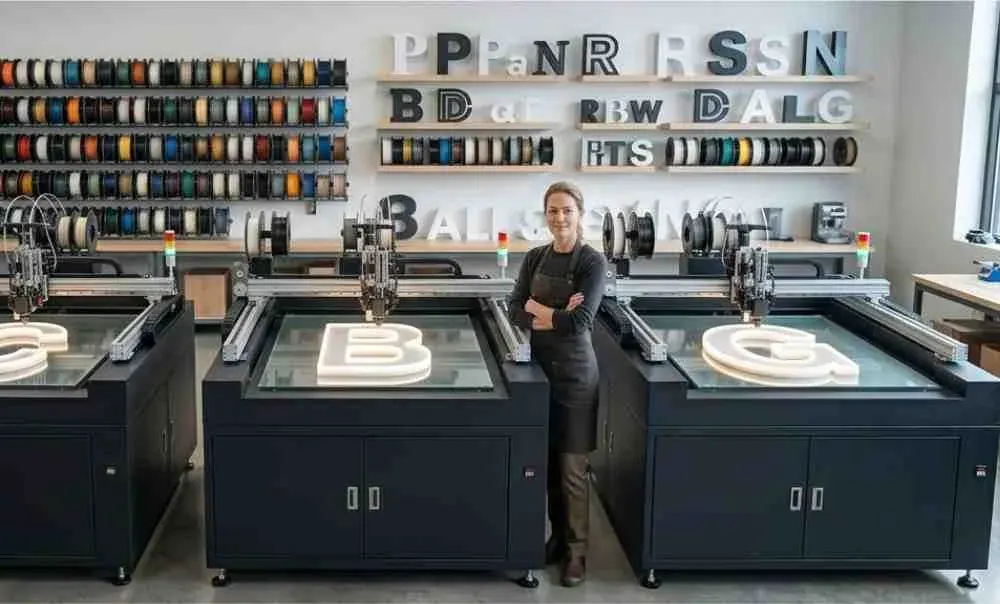
Producing channel letters on a 3D printer changes the maths. The marginal cost of a letter is tiny:
- Filament: roughly £3.15-£3.70 for a typical 30 × 40 × 5 cm letter (about 60-70 m of a £20.99 spool of HFPC).
- Electricity: the machine runs on 1-2 kWh for a full 24 hours of printing – about 27-54p a day, less than a coffee.
- Labour during printing: effectively zero. The machine is fully automated and runs unattended, and one operator can mind several machines at once.
So instead of paying a fabricator’s price for each letter, your production cost drops to a few pounds of material plus the finishing you’d do anyway. You keep the full margin on every job, and the savings compound the more you produce. The complete per-letter and payback picture is in our ROI breakdown, and the machine pricing is in our cost guide.
Turnaround and control: the real advantage
Money aside, the biggest day-to-day change is control. With a printer in your own workshop you can:
- Produce overnight. Set a job running at the end of the day and have letters ready in the morning – no queue, no waiting on a supplier.
- Make changes on the spot. A size or colour revision is your decision, not a back-and-forth with a fabricator.
- Say yes to tight deadlines. When a client needs a sign quickly, you can deliver it – which wins work you’d otherwise turn away.
- Guarantee consistency. Every letter comes out identical, finished to your standard.
For many shops this is worth more than the cost saving: it turns channel letters from a logistical dependency into something you control end to end. If you’re weighing up building this into a core service, our guide to starting a 3D letter sign business covers the wider picture.
The break-even: how much volume justifies it?
The simplest way to judge the switch is to compare what you currently pay to outsource a letter with what it costs to make one in-house.
Illustrative example (use your own figures):
- What you currently pay a fabricator per letter: £45
- Your in-house production cost per letter: ~£25 (≈ £3.50 filament + electricity, plus lighting and finishing)
- Saving per letter: ~£20 – before you even count the margin you keep by not outsourcing the work at all.
On the saving alone, here’s roughly how quickly an entry SG-S 3D Ultra (£3,900) pays for itself:
| Letters / month | Monthly saving vs outsourcing | Machine recouped in |
|---|---|---|
| 10 | £200 | ~20 months |
| 20 | £400 | ~10 months |
| 50 | £1,000 | ~4 months |
| 80 | £1,600 | ~2.5 months |
And that’s the conservative view, because it only counts the cost you stop paying the fabricator. The bigger return comes from the extra work you can now win and the full job margin you keep – which is what the ROI breakdown models. As a rule of thumb, if channel letters are a steady, recurring part of your work, bringing production in-house usually pays for itself within months, not years.
Frequently asked questions
Is it cheaper to make channel letters in-house or outsource them? For regular work, in-house is almost always cheaper. The marginal cost of a 3D-printed letter is a few pounds of filament and pennies of electricity, versus a fabricator’s price on every job — and you keep the full margin.
How many letters a month do I need to justify a 3D printer? It depends on what you currently pay to outsource. On an illustrative £20-per-letter saving, an entry machine pays for itself in around 10 months at 20 letters a month, or about 4 months at 50 — and faster once you factor in the extra work you can take on.
Do I need 3D-printing experience to bring production in-house? No. SG machines use automated, one-button operation, and on-site UK training is included so your team can produce confidently from day one.
What if I only do channel letters occasionally? For genuinely rare jobs, outsourcing can still make sense. The in-house case strengthens as channel letters become a regular part of your workload.
See it in your own workshop
The best way to judge whether to bring production home is to see a machine produce letters for yourself. Book a demo and we’ll show you the workflow, the finish and the numbers for your shop. To run the cost comparison first, start with our ROI breakdown and price guide.
Break-even figures in this article are illustrative and provided to help you model your own numbers; they are not a guarantee of results.
Frequently asked questions
Is it cheaper to make channel letters in-house or outsource them? For regular work, in-house is almost always cheaper. The marginal cost of a 3D-printed letter is a few pounds of filament and pennies of electricity, versus a fabricator’s price on every job – and you keep the full margin.
How many letters a month do I need to justify a 3D printer? It depends on what you currently pay to outsource. On an illustrative £20-per-letter saving, an entry machine pays for itself in around 10 months at 20 letters a month, or about 4 months at 50 – and faster once you factor in the extra work you can take on.
Do I need 3D-printing experience to bring production in-house? No. SG 3D Printers machines use automated, one-button operation, and on-site UK training is included so your team can produce confidently from day one.
What if I only do channel letters occasionally? For genuinely rare jobs, outsourcing can still make sense. The in-house case strengthens as channel letters become a regular part of your workload.
See it in your own workshop
The best way to judge whether to bring production home is to see a machine produce letters for yourself. Book a demo and we’ll show you the workflow, the finish and the numbers for your shop. To run the cost comparison first, start with our ROI breakdown and price guide.
Break-even figures in this article are illustrative and provided to help you model your own numbers; they are not a guarantee of results.