Sign-Making Running Costs: Why an Energy-Efficient 3D Printer Protects Your Margins
Published Updated
Energy prices have been one of the sharpest pressures on UK businesses in recent years, and for a sign shop the cost of simply running your equipment quietly eats into the margin on every job.
Most sign makers focus on materials and labour – and rightly so – but the power your machines draw is a real, recurring cost that’s easy to overlook. This is one area where 3D-printed signage stands apart, because a channel-letter 3D printer is remarkably cheap to run. Here’s the running-cost picture, and why energy efficiency matters more than you might think.
The running costs that quietly eat your margin
The true cost of producing a sign isn’t just the material. It’s the sum of:
- Energy – the electricity to run your production equipment.
- Materials – substrate, acrylic, metal, filament.
- Labour – the skilled hours that go into making each sign.
- Waste – offcuts and failed pieces you’ve paid for but can’t sell.
- Outsourcing – the mark-up you hand a fabricator when work goes out of house.
Trim any of these and your margin improves. Energy and labour are the two that traditional fabrication tends to load up on – and they’re exactly the two that 3D printing keeps low.
What it costs to run a channel-letter 3D printer
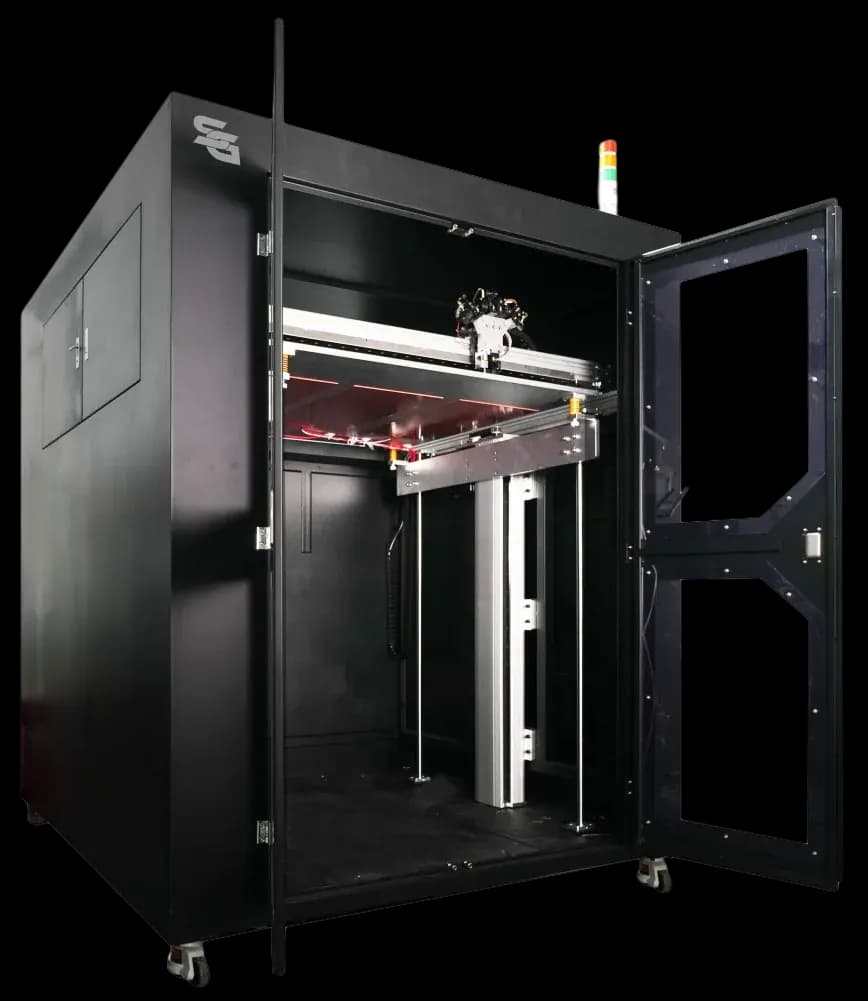
Here are the actual numbers for an SG channel-letter printer:
- Electricity: the machine draws just 1-2 kWh over a full 24 hours of printing. That’s an average of only around 40-80 watts – less than a couple of lightbulbs. At 2026 UK business electricity rates of roughly 26-28p per kWh, a full day of printing costs about 27-54p.
- Run it every day for a year and you’re still looking at only around £100–£200 in electricity – for a machine producing signage around the clock.
- Filament: roughly £3.15-£3.70 for a typical 30 × 40 × 5 cm letter.
- Labour: effectively zero during printing. The machine runs fully automated and unattended, and one operator can oversee several machines at once.
So the running cost of producing a letter is a few pounds of filament, pennies of power, and almost no labour. That’s a fundamentally different cost base from traditional fabrication.
How that compares to traditional sign-making kit
Traditional dimensional signage leans on powerful, power-hungry equipment – CNC routers, laser cutters, and the vacuum pumps, compressors and chillers that run alongside them. These are excellent tools, but they draw far more power per hour of operation.
Depending on the machine, a laser cutter’s total draw (once you include its chiller and extraction) commonly runs from around one-and-a-half kilowatts up to six or eight kilowatts, and a large CNC router with vacuum and compressor can draw several kilowatts more.
In practice, running that kind of kit can cost a few pounds an hour in electricity alone – before you add the skilled labour needed to operate it.
Set against a 3D printer averaging 40–80 watts and running unattended, the contrast is stark: for producing dimensional letters specifically, you’re swapping a labour- and power-intensive process for one that sips electricity and needs no one standing over it.
Why energy efficiency is a margin lever
It’s tempting to dismiss electricity as a rounding error, but over a year of production the difference compounds – and the bigger story is what low energy use unlocks:
- Output without proportional cost. Because the machine runs 24/7 unattended at a tiny power draw, you can scale production without scaling your energy bill or your wage bill. More signs don’t mean proportionally more cost.
- Predictable, tiny overheads. When your production equipment costs pennies a day to run, your cost per job is dominated by material – which is cheap and predictable – not by volatile energy and labour.
- Room to price competitively. Lower running costs mean healthier margins, or the flexibility to win work on price without losing money.
The full cost-per-letter picture
Put it together and a 3D-printed letter costs a few pounds of filament, a negligible amount of electricity, and minimal maintenance to produce — with no fabricator’s mark-up when you make it in-house. That’s why the economics are so compelling, as our ROI breakdown sets out in full, and why so many shops are bringing production in-house rather than outsourcing it. For machine pricing, see our cost guide.
Why this matters now
With energy costs where they are, low running costs aren’t a nice-to-have – they’re a competitive advantage. Equipment that produces around the clock for the price of a coffee a day protects your margins against rising bills, keeps your cost per sign predictable, and lets you take on more work without your overheads climbing in step. There’s an environmental upside too: a machine drawing 40–80 watts has a far smaller carbon footprint than traditional fabrication kit, which is increasingly something clients ask about.
Frequently asked questions
How much does it cost to run a channel-letter 3D printer? About 27-54p a day in electricity (1-2 kWh over 24 hours at UK business rates), plus roughly £3.15-£3.70 of filament per typical letter. Run every day for a year, the electricity comes to only around £100-£200.
Is a 3D printer cheaper to run than a CNC router or laser cutter? For producing dimensional letters, yes – by a wide margin. CNC routers and laser cutters (with their ancillary equipment) typically draw several kilowatts while running and need an operator, whereas a channel-letter 3D printer averages 40-80 watts and runs unattended.
What’s the electricity cost of running one continuously? At around 1-2 kWh per 24 hours, continuous use costs roughly 27-54p a day, or about £100-£200 a year – a negligible overhead for the output.
Does it cost more to run overnight? No – overnight running is where the value is. The machine produces while you’re not paying anyone to watch it, at the same tiny power draw, so your capacity isn’t limited by working hours.
See the running costs for your shop
Want to see how low-cost, around-the-clock production could work in your business? Book a demo or call us on +44 203 620 1605, and we’ll walk you through the numbers. To model the full economics first, start with our ROI breakdown.
Running-cost figures are illustrative and depend on your machine, usage and electricity tariff. Equipment power figures for other kit are typical industry ranges and vary by machine and configuration.