Industrial 3D Printers: A UK Buyer’s Guide (2026)
Published
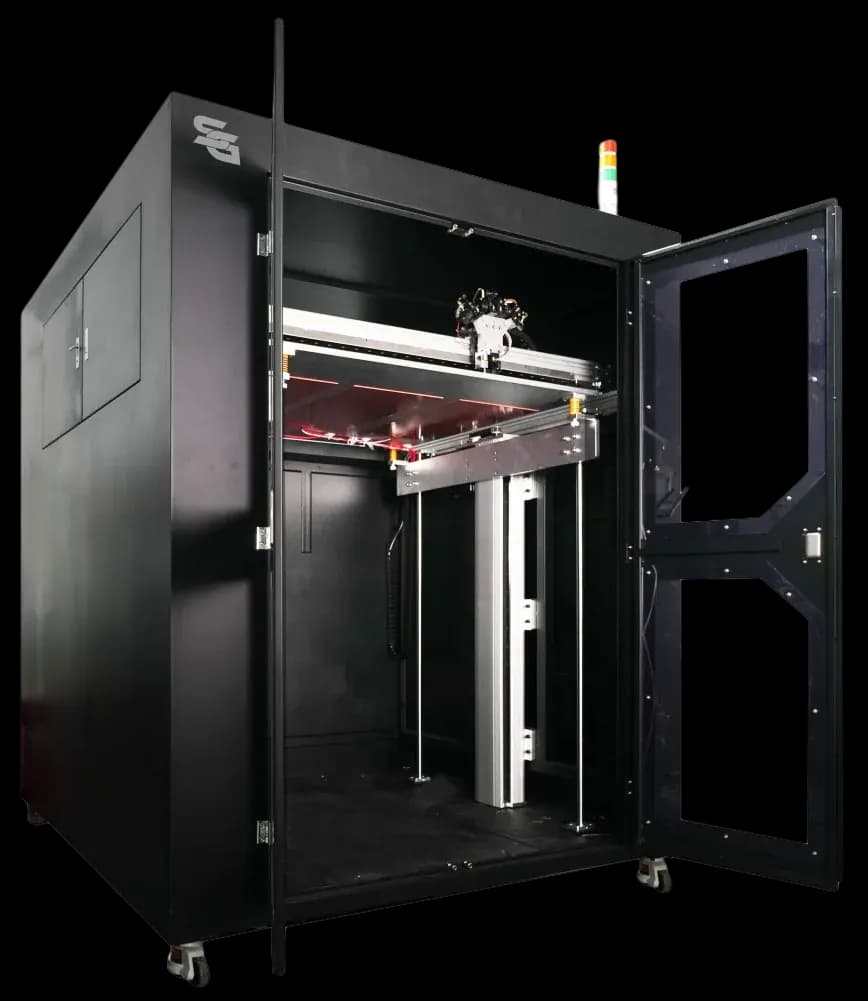
Industrial 3D printers have moved from a niche prototyping tool to a serious production asset across signage, manufacturing, architecture and design.
But “industrial 3D printer” covers a huge range of machines, and choosing the right one – for the work you actually do – matters far more than the spec-sheet headlines. This guide explains what an industrial 3D printer is, what you can make with one, what to look for, and where SG’s UK range fits, from signage letters to a full cubic-metre build volume.
What is an industrial 3D printer?
An industrial 3D printer is a machine built for professional, repeatable production rather than occasional hobby use. The differences from a desktop printer are practical ones that affect your output and your bottom line:
- A large build volume, so you can produce big components – or many parts – in a single print, reducing assembly and post-processing.
- Reliability for long, continuous runs, often unattended, with features like power-outage recovery to protect multi-hour jobs.
- A wider range of materials and higher temperatures, so you’re not limited to basic PLA.
- A robust, semi-enclosed frame for stability and consistent quality during high-speed or high-temperature printing.
- Professional support and a warranty behind the machine.
Most industrial 3D printers in this class use FDM (Fused Deposition Modelling) – laying down thermoplastic layer by layer – which combines a low running cost with strong, functional results across a broad material range.
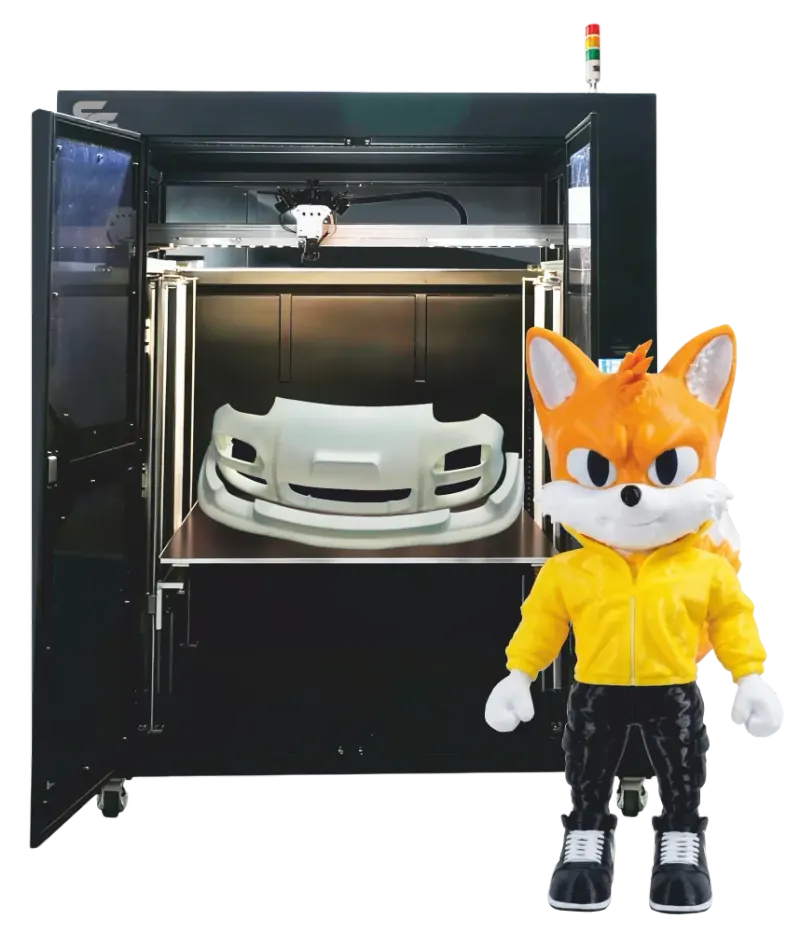
Industrial vs desktop 3D printers
| Desktop / hobby | Industrial | |
|---|---|---|
| Build volume | Small (often ~200-300 mm) | Large (500 mm up to 1 metre+) |
| Use pattern | Intermittent, supervised | Continuous, long unattended runs |
| Materials | Mostly PLA | PLA, ABS, PETG, HFPC, composites; high-temp nozzles |
| Reliability features | Minimal | Power-outage recovery, enclosed frame, touchscreen control |
| Support | Consumer-level | Professional support and warranty |
The right machine is the one whose build volume, materials and reliability match your work – not simply the largest or the cheapest.
What can you make with an industrial 3D printer?
The appeal of industrial 3D printing is its versatility. Common applications include:
- Large-format signage and channel letters – illuminated letters and dimensional signs, produced in-house at a fraction of fabrication cost.
- Rapid prototyping and functional parts – turning designs into testable, working parts quickly.
- Sculpture, props and displays – large three-dimensional pieces for retail, exhibitions and events.
- Architectural models and elements – detailed scale models and bespoke components.
- Low-volume manufacturing – short production runs without the tooling costs of traditional methods.
- Industrial design and engineering – strong, heat-resistant parts for sectors such as automotive, aerospace and architecture.
What to look for when choosing an industrial 3D printer
Judge any industrial 3D printer against the things that affect your work day to day:
- Build volume. Match it to your largest typical part. A 500 mm machine covers a great deal; a 1-metre machine handles oversized work in one piece.
- Materials and nozzle temperature. A higher nozzle temperature (up to 320°C on SG’s industrial machines) unlocks engineering-grade and composite materials, not just PLA.
- Single or dual nozzle / multi-material. Dual-nozzle and multi-material feeding allow support structures, multiple colours and more complex geometries.
- Speed and resolution. Look for a usable range – fine layers (from 0.05 mm) for detail, fast speeds (up to 500 mm/s) for productivity.
- Reliability features. Power-outage recovery and a stable, semi-enclosed frame protect long jobs and your material.
- Software compatibility. Compatibility with standard slicers (such as Cura and Simplify3D) and your operating systems keeps it easy to adopt.
- UK support, spares and warranty. Downtime is lost revenue – local support and stocked spares matter as much as the spec.
- Finance options. The ability to spread the cost lets the machine pay for itself from the work it produces.
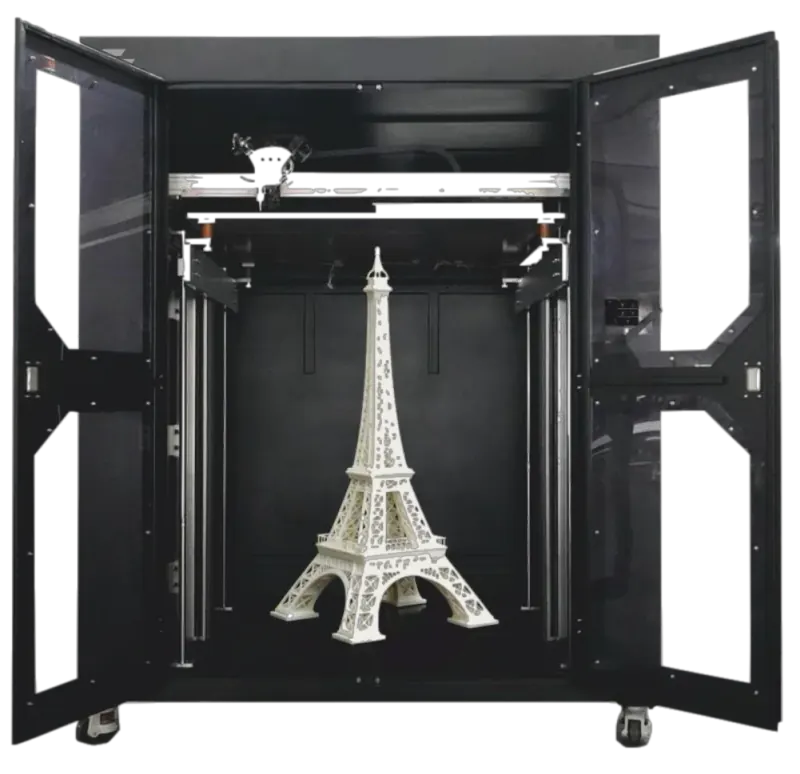
SG’s industrial 3D printer range
SG 3D Printers supplies industrial 3D printers across two families: a signage-focused channel-letter range and a large-format industrial range for prototyping, manufacturing and oversized work.
For large-format and manufacturing work:
| Machine | Build volume | Nozzle temp | Best for | Price (from) |
|---|---|---|---|---|
| SG-P556 T | 500 × 500 × 600 mm | up to 320°C | Prototyping, functional parts, low-volume production | £6,000 |
| SG-INT P1000 | 1000 × 1000 × 1000 mm | up to 320°C | Large-scale production and oversized parts | £11,600 |
The SG-P556 T pairs a 500 × 500 × 600 mm build volume with a multi-material feeding system, single or optional dual nozzle, a 3.5-inch colour touchscreen with multilingual voice interface, and power-outage resumption – running PLA, ABS, PETG and HFPC at speeds of 100-500 mm/s and resolutions from 0.05 mm. The SG-INT P1000 scales this up to a massive 1000 × 1000 × 1000 mm build area with a 7-inch touchscreen, support for composites alongside standard thermoplastics, and a rigid integrated structure for consistent quality on long jobs – built for automotive, aerospace, architecture and industrial-design production.
SG 3D Printers also offers compact four-colour industrial machines – the SG-T1 60 and SG-T1 100 – for multi-colour work. You can see the full line-up in the industrial & sculpture printer range.
For signage and channel letters:
The SG-S 3D Ultra (80 × 80 cm, from £3,900) and SG-S L2S Pro (120 × 120 cm, from £8,800) are purpose-built for illuminated channel letters and signage. They run fully automated and unattended, draw just 1-2 kWh over 24 hours of printing, and let one operator oversee several machines at once – ideal for a sign business producing letters at scale. See our price guide and best channel-letter printers guide for more.
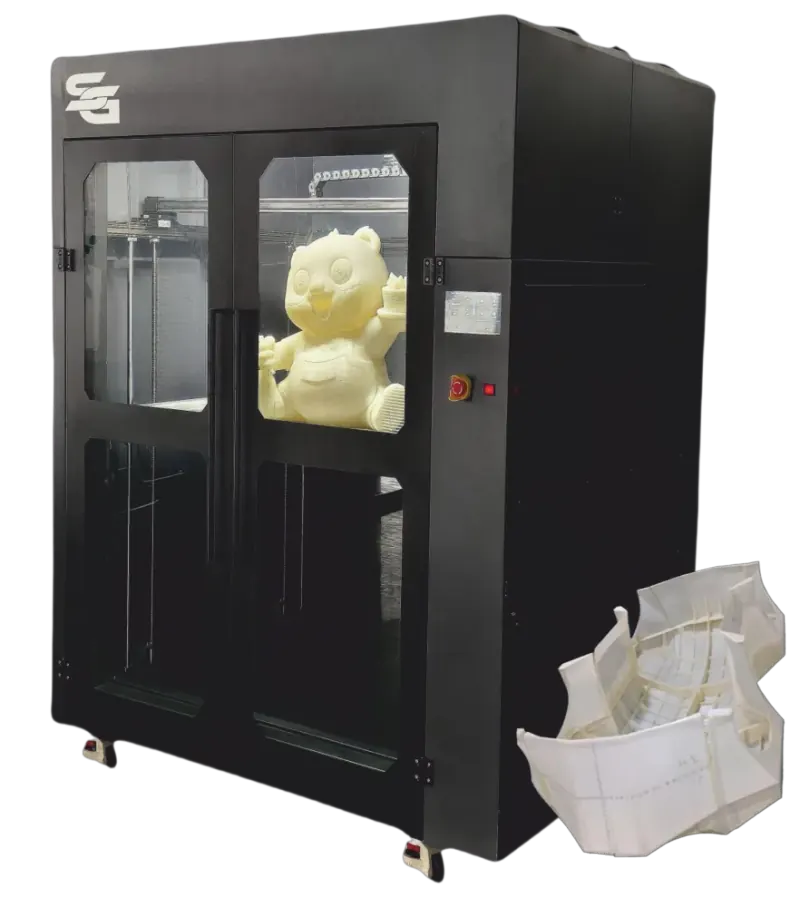
Industrial 3D printing for signage and large-format work
For sign makers and large-format producers, an industrial 3D printer is genuinely transformative. Channel letters and dimensional signage that once took hours of skilled hand-fabrication can be produced in-house, overnight, in a purpose-made signage material (HFPC) – at a material cost of only a few pounds per letter. It removes the skilled-labour bottleneck, removes the “complexity penalty” for detailed or script lettering, and gives you full control over turnaround. Our ROI breakdown shows how quickly the signage machines pay for themselves.
Running costs and value
A key advantage of FDM industrial 3D printers is low running cost: the main consumable is filament, and the marginal cost per part is small compared with traditional manufacturing or fabrication. Producing components – or signage letters – in-house also cuts outsourcing costs and tooling, and shortens lead times. For the signage range specifically, the energy draw is exceptionally low (around 1-2 kWh per 24 hours of printing), which protects your margins further over the life of the machine.
Why buy your industrial 3D printer in the UK
Where you buy matters as much as what you buy. SG printers are assembled and supported in the UK, with on-site training, locally stocked spare parts and a 2-year warranty. When a machine is central to your production, that local backing is the difference between a quick fix and a long, costly wait on an overseas supplier. Flexible finance and leasing are also available to spread the cost – see our finance page.
Frequently asked questions
What is an industrial 3D printer? A machine built for professional, repeatable production rather than hobby use – with a large build volume, support for a wide range of materials and high temperatures, reliability features for long unattended runs, and professional support and warranty. Most use FDM technology.
How much do industrial 3D printers cost in the UK? SG’s range runs from £3,900 for a signage channel-letter machine (SG-S 3D Ultra) up to £11,600 for a 1-metre large-scale industrial machine (SG-INT P1000), with the SG-P556 T at £6,000. The right price depends on build volume and configuration.
What can you make with an industrial 3D printer? Large-format signage and channel letters, prototypes and functional parts, sculpture and display pieces, architectural models, and low-volume production parts in materials including PLA, ABS, PETG, HFPC and composites.
What’s the difference between a desktop and an industrial 3D printer? Build volume, reliability and materials. Industrial machines are built for large parts, continuous unattended production and engineering-grade materials at higher temperatures, with professional support behind them.
Can industrial 3D printers run continuously? Yes. SG’s industrial machines are designed for long production runs, with features such as power-outage recovery and stable semi-enclosed frames; the signage machines run unattended around the clock.
Talk to a UK industrial 3D printer supplier
Whether you need large-format signage, prototyping and production parts, or a full cubic-metre build volume, we’ll help you choose the right industrial 3D printer for your work – not the most expensive one. Request a quote or book a demo, or call us on +44 203 620 1605. To compare costs first, start with our price guide.