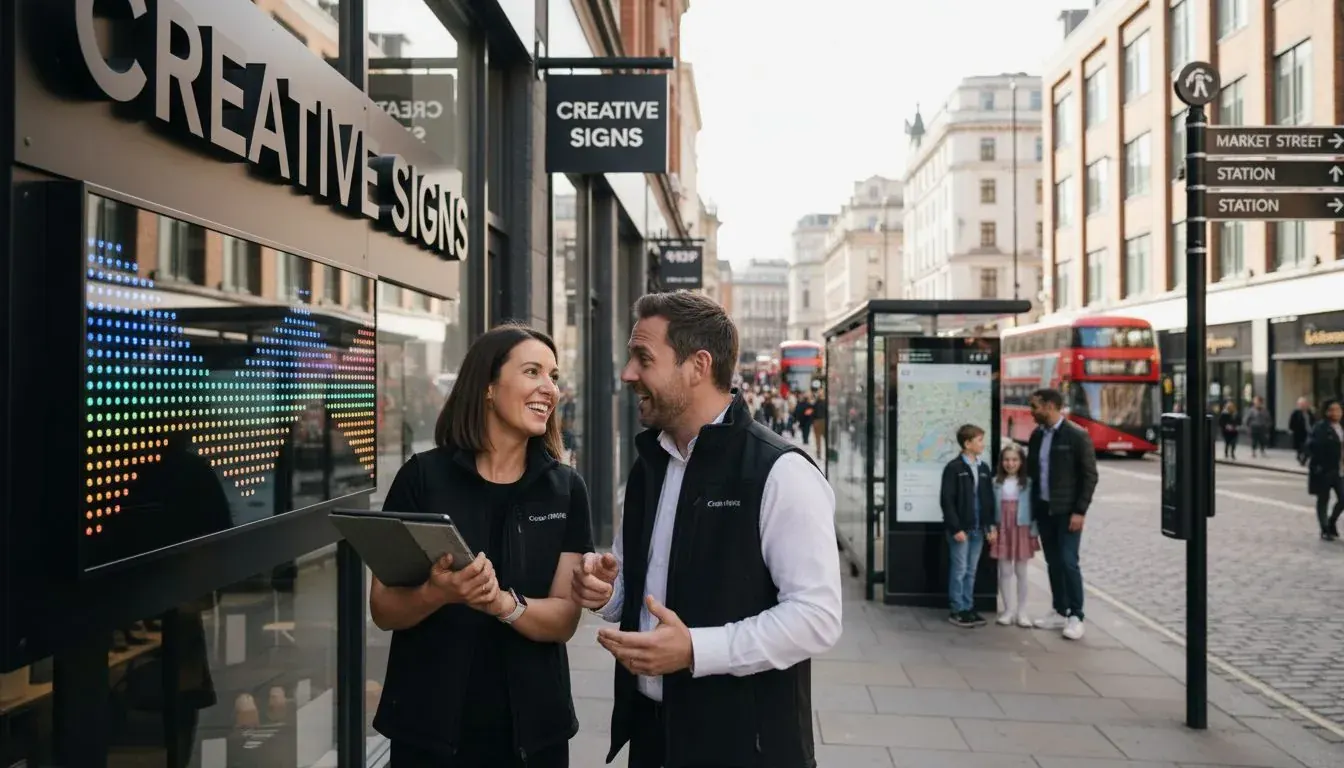
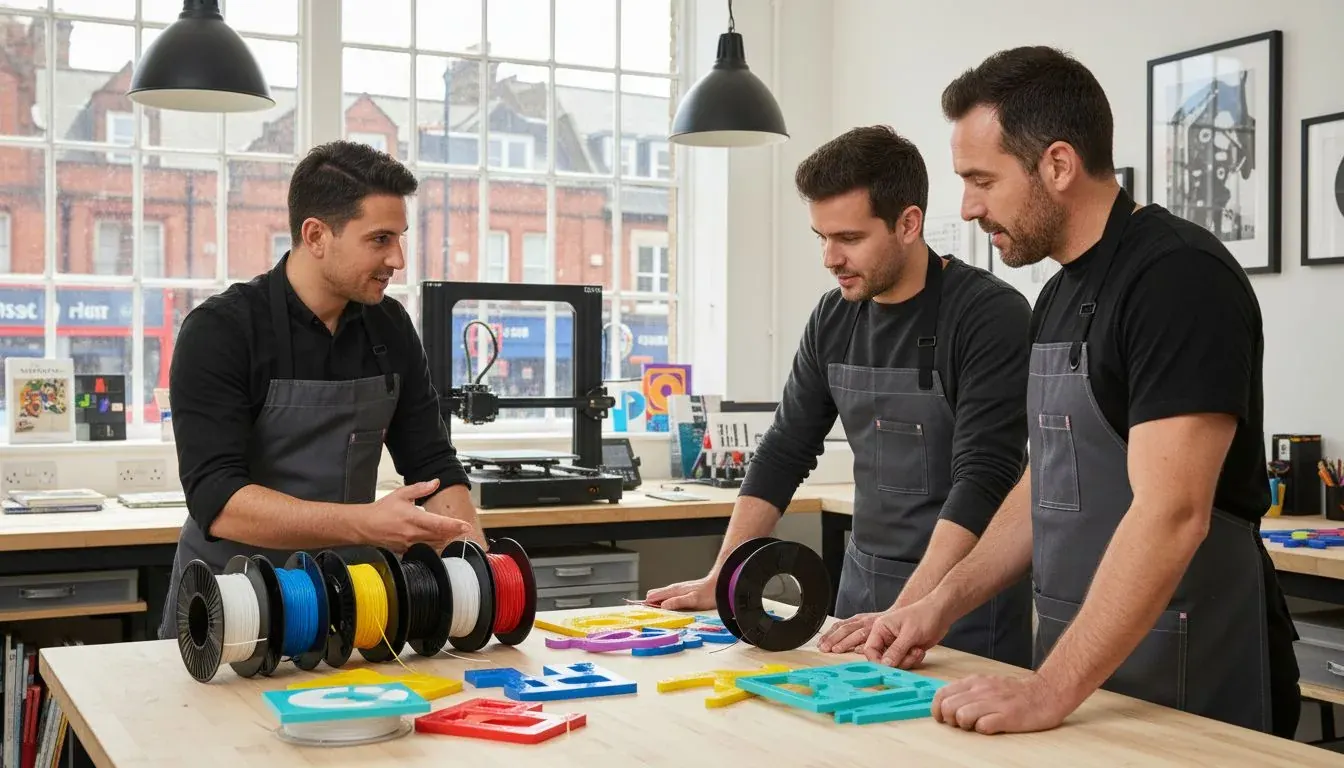
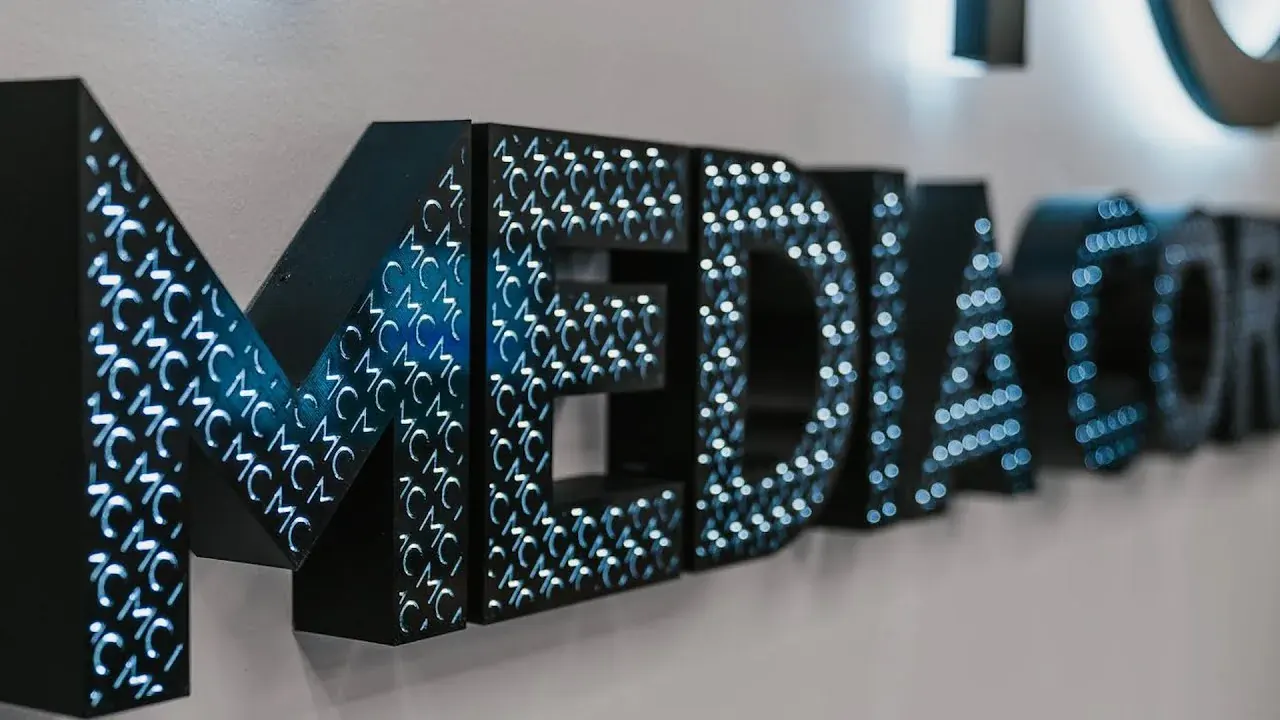
Large-Scale 3D Printed Channel Letters: Cost & Innovation
Published Updated
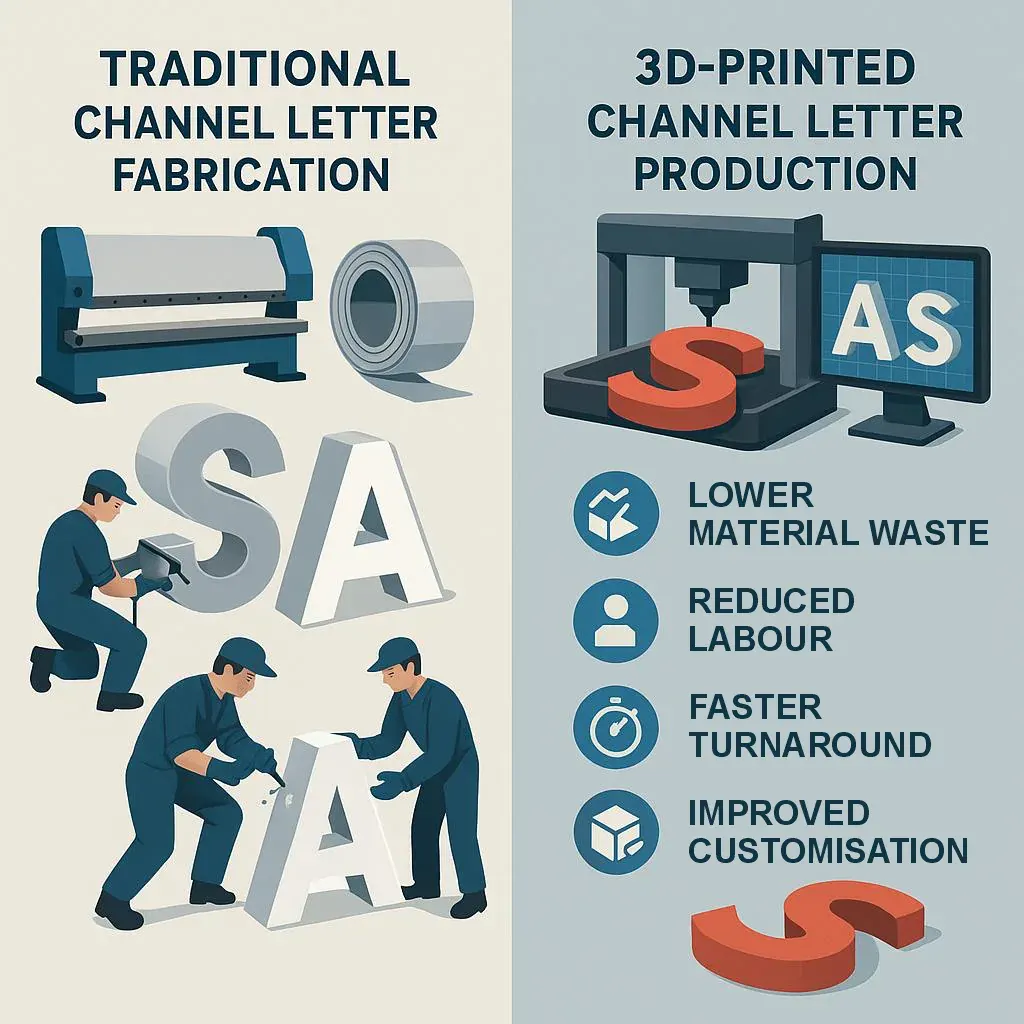
Revolutionising Signage: Large-Scale 3D Printing for Channel Letters
In the signage industry, channel letters – those three-dimensional, often backlit letters on storefronts or corporate buildings – have traditionally been fabricated using time-honoured methods: bending aluminium returns, cutting acrylic faces, welding, painting, and assembly. But thanks to advances in large-format 3D printing, a new paradigm is emerging.
With the right equipment and materials, sign makers can manufacture channel letters faster, more flexibly, and at significantly lower cost – all while unlocking creative possibilities that were previously difficult or expensive.
In this post, we’ll explore:
- What large-scale 3D printing for channel letters involves.
- The cost-efficiency benefits.
- How one-click design software (e.g., from Sign Group) simplifies the process.
- A detailed comparison: 3D-printed vs traditional channel letters.
- A case study: how Tractus3D shook up the channel letter industry.
What Is Large-Scale 3D Printing for Channel Letters?
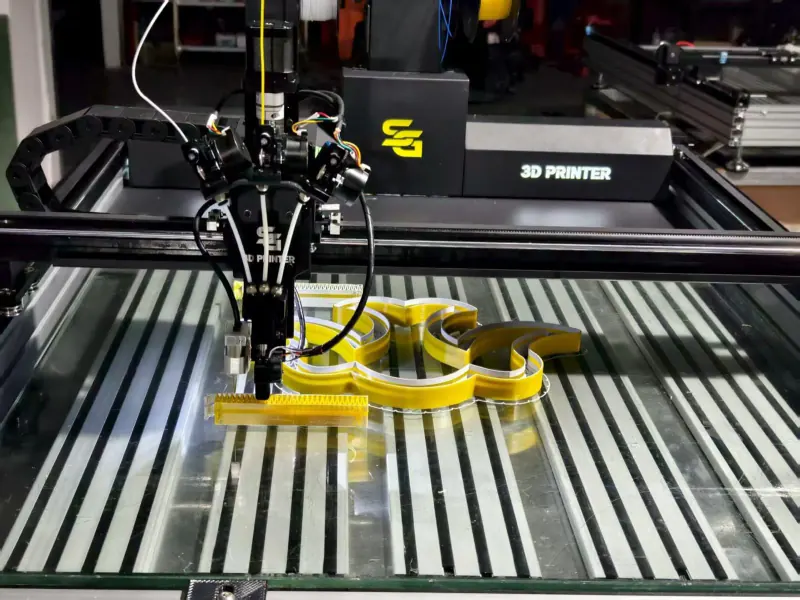
When we talk about “large-scale” 3D printing in the context of signage, we generally mean industrial/production-grade Fused Deposition Modeling (FDM) or hybrid systems with bed sizes and build volumes optimized for lettering. Rather than printing small trinkets or prototypes, these machines are designed to extrude specialty polymers into full-sized channel-letter bodies.
For instance, Sign Group offers 3D printers (e.g., the SG-S 3D ULTRA and SG-S 3D Pro ULTRA) built specifically for sign production. According to their spec sheet, these printers support:
- Very large build volumes (up to 1,200 × 1,200 mm) for sizable letters.
- Continuous 24-hour operation.
- Specialized filaments like HFPC (High-Flexible Polymer Composite), engineered for outdoor, light-diffusing, UV-resistant signage.
- Optional UV-curing modules for acrylic faces – enabling hybrid manufacturing (printed body + liquid acrylic face).
These machines are purpose-built: they are not simply repurposed hobby printers scaled up – they are engineered for the repetitive, high-quality demands of commercial channel letter production.
Cost Efficiency: Why Large-Scale 3D Printing Saves Money
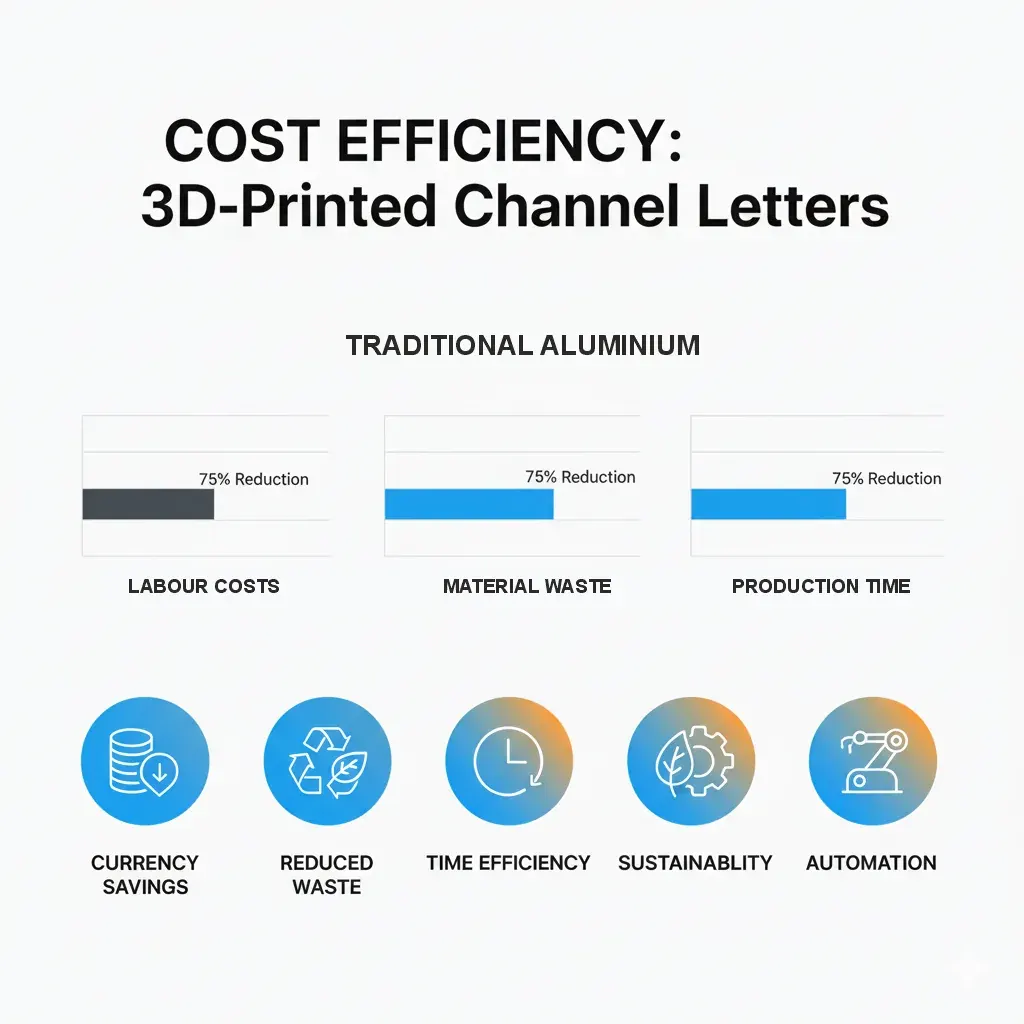
One of the strongest arguments for using large-format 3D printers for channel letters is cost efficiency. Several levers contribute to this:
1. Labour Reduction
- Traditional channel letter production involves skilled labour (cutting, bending, welding, finishing). This is labour-intensive and time-consuming.
- In contrast, purpose-built 3D printers like Sign Group’s run unattended for many hours, with minimal operator intervention. That means fewer labour hours spent on construction and more time available to focus on finishing, assembly, or other value-add tasks.
- As noted by Sign Group, one person can manage multiple machines concurrently, further diluting labour cost per letter.
2. Material Efficiency and Waste Reduction
- With 3D printing, material usage is tightly controlled: only as much filament is used as needed for the letter shape. Compared to traditional methods (metal off-cuts, acrylic scrap), this reduces waste.
- Many filaments used in signage are recyclable or specially formulated to minimize waste.
- Also, production can be optimized around printing efficiency, minimizing “air” prints and maximizing volume utilization.
3. Operating Costs
- Sign Group’s SG-S Ultra reportedly uses only 1–2 kWh of electricity for 24 hours of operation.
- Lower energy consumption, plus minimal manual intervention, means running costs can be significantly lower than traditional fabrication equipment (metal working, welding, large workshop tools).
4. Faster Turnaround and Scalability
- Because the printers are large and can run continuously, sign shops can produce entire jobs in fewer machine cycles.
- There’s no need for bending jigs, welding fixtures, or manual alignment. This reduces lead times, and businesses can deliver orders faster, improving cash flow.
- Consistency across letters is high: once a digital file is set, every letter printed is identical, reducing rework and quality control costs.
5. Quantified Savings from a Case Study
- In a well-documented case, Styles Werbetechnik, a German signage company, worked with Tractus3D to integrate large-format 3D printing into their channel letter production. During their evaluation, they found that 3D printing could reduce costs by up to 30% compared to their previous conventional fabrication methods. 3DPrint
- Key factors behind this cost reduction included continuous, unattended printing, lower filament costs, and almost zero waste.
Ease of Use: One-Click Design Software from Sign Group
One of the biggest barriers to adopting 3D printing for sign shops is often the design workflow: how do you convert a 2D logo or font into a proper 3D channel letter ready to print? That’s where Sign Group’s integrated software comes in.
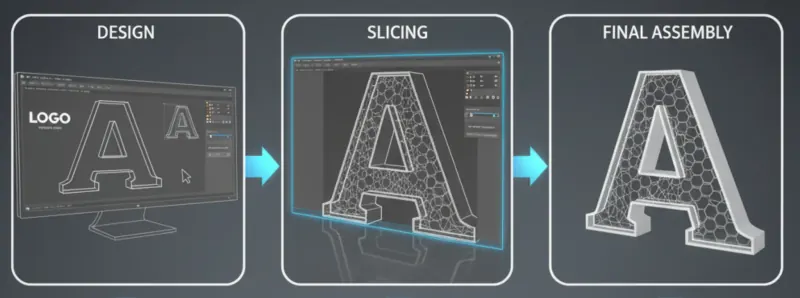
The One-Click Process
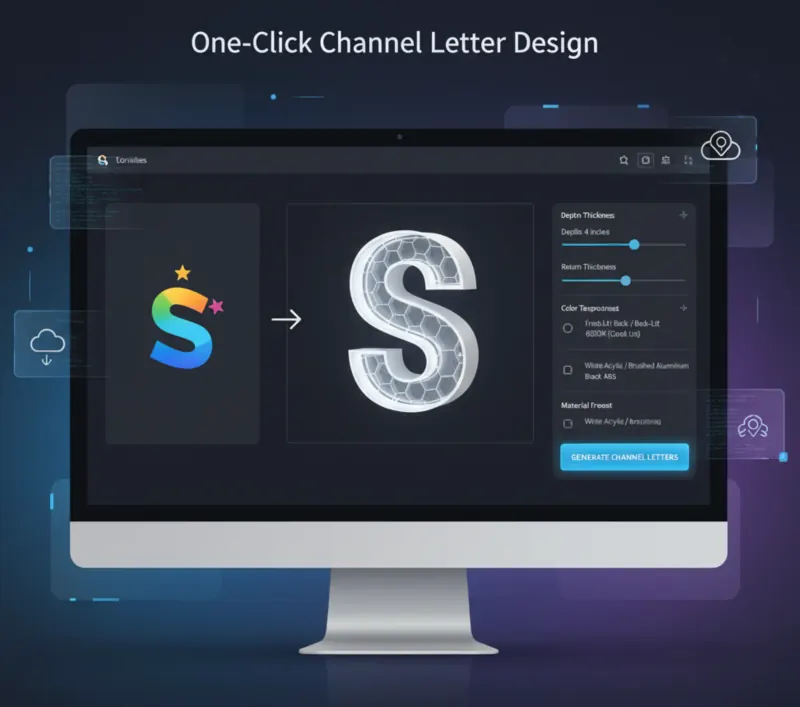
- Their printers support one-click 3D file generation, meaning minimal setup or manual CAD work is required. According to Sign Group, you upload your vector design, set parameters (e.g., letter depth, wall thickness), and the system generates a printable 3D model automatically. Sign Group
- This “one-click” pipeline includes stages from CDR (CorelDraw) design → INC slicing → 3D preview → printing, all integrated in a simplified touch-screen workflow.
- For users unfamiliar with CAD, this is a huge time-saver: there’s no need to learn complex 3D modelling tools.
Advantages of the One-Click Approach
- Speed: Designers and production teams don’t need to manually build or tweak 3D models letter by letter.
- Consistency: Every letter generated from the same settings is consistent, critical for brand signage.
- Accessibility: Even sign shops without dedicated CAD experts can adopt 3D printing.
- Error Reduction: Fewer manual steps mean fewer opportunities for design or slicing mistakes.
3D-Printed vs Traditional Channel Letters: A Head-to-Head Comparison
To fully appreciate the impact of 3D printing, it helps to compare it directly with conventional channel letter fabrication.
Traditional Channel Letters: Pros & Cons
Pros:
- Proven Durability: Metal (often aluminum) returns are robust; acrylic faces are well-understood and long-established.
- High-Quality Finish: Through bending, welding, painting, and polishing, sign makers can achieve premium results.
- Industry Familiarity: Most sign shops already use traditional tools and have expertise, so workflows and standards are established.
Cons:
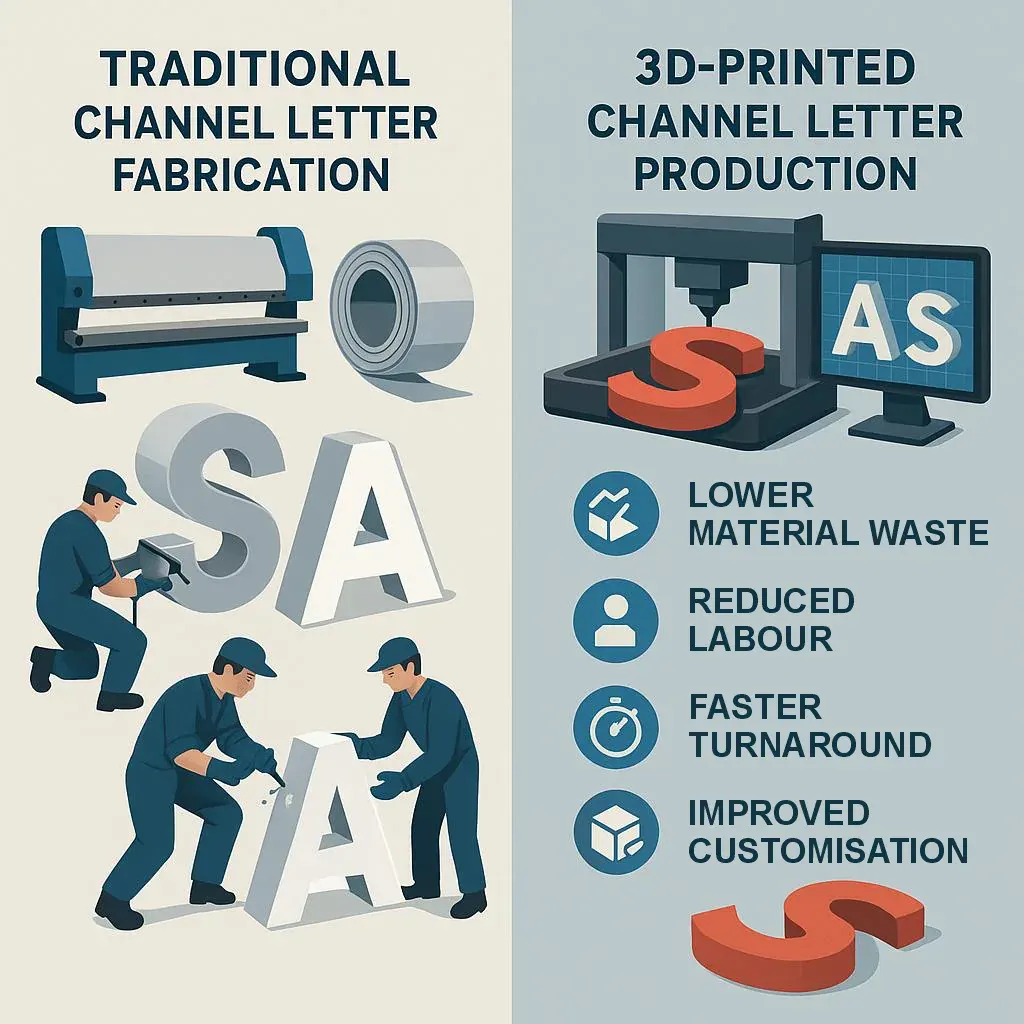
- Labour-Intensive: Cutting, bending, welding, and assembly require skilled labour.
- Design Constraints: Sharp corners, intricate fonts, or ultra-thin profiles are difficult or expensive to make.
- Material Waste: Scraps from metal bending and off-cuts from acrylic faces can be significant.
- Longer Lead Times: Any design change often requires re-jigging templates or revising production tooling.
- Cost Overheads: Labour, tooling, and workshop space are expensive.
3D-Printed Channel Letters: Pros & Cons
Pros:
- Design Freedom: 3D printers can produce complex shapes, curves, serifs, and shallow depths (as low as 25-30 mm) that are hard to achieve with metal fabrication. Sign Group
- Automation & Speed: With one-click design software and continuous printing, sign shops can turn jobs around faster.
- Cost Savings: Reduced labour, minimal waste, lower energy usage, and more consistent output drive down costs.
- Scalability: Once set up, the same digital file can be printed identically across multiple machines or over time.
- Sustainability: Less scrap, more efficient material use, and recyclable or weather-resistant filament reduce environmental impact.
- Ultra-small or Thin Letters: 3D printing makes even very small or shallow letters feasible and cost-effective.
Cons:
- Initial Investment: Large-format 3D printers and specialized filaments can require substantial upfront capital.
- Material Limitations: While HFPC and PMMA blends are great, they may not match the rigidity or certain mechanical properties of metal in every use-case.
- Print Speed: Depending on machine, size, and resolution, printing large letter bodies can take many hours.
- Post-Processing: Some finishing (polishing, sanding, face application) is still needed, particularly for premium signage.
- Technical Skill: Although one-click systems simplify design, technicians still need to manage maintenance, calibration, filament drying, etc.
Case Study: Tractus3D’s Impact on the Channel Letter Industry
A compelling real-world example comes from Styles Werbetechnik, a leading German signage company, and their partnership with Tractus3D – a large-format 3D printer manufacturer.
From the 3DPrint.com article:
Styles Werbetechnik wanted a scalable, future-proof system to produce profile/channel letters in a variety of shapes, sizes, and materials using a single production method.
They first trialled the Tractus3D T1250 – a “desk” printer with a build diameter of 35 cm and height up to 60 cm – for smaller letters. The accuracy and surface quality of the prints were so good that, in just a few hours, the test letters could be installed.
Once the test phase succeeded, they stepped up to the T3000, a truly large-format machine with a one-meter diameter build area. During stress testing, the Tractus3D printer proved capable of printing difficult shapes, sharp serifs, and other design details – which the company had previously struggled to manufacture with traditional methods.
Importantly, they found that 3D printing allowed them to reduce the minimum depth of illuminated letters: while traditional methods struggled below ~60 mm, the 3D printer could produce letters as shallow as 30 mm, still with space for lighting and structural integrity.
Financially, the result was substantial: costs dropped by up to 30%. The reasons included round-the-clock printing without supervision, cheaper filament raw material, and very low material waste compared to metal fabrication.
The article quotes one of the involved parties: “3D printing is the future of profile advertising systems.”
This case clearly illustrates how large-format 3D printing isn’t just a novelty – it’s capable of disrupting long-standing sign production processes, delivering both financial and design advantages.
Putting It All Together: Why Sign Makers Should Consider 3D
Given the data, it’s clear why more sign shops are seriously evaluating large-scale 3D printing:
- Lower cost per letter – thanks to reduced labour and material waste, plus efficient operations.
- Greater creative freedom – you can design shapes and depths that were previously uneconomical or technically difficult.
- Scalable production – once you have the digital file, repeatability is near perfect.
- Faster and more flexible workflows – especially with one-click software, which lowers the skill barrier and accelerates job turnaround.
- Sustainability gains – less scrap, more eco-friendly materials, and lower energy usage.
- Better visuals – ultra-thin or detailed letters, high light diffusion, and seamless surfaces.
Challenges & Considerations Before Adopting
Of course, any shift to 3D printing has challenges:
- CapEx: Purchasing a large-format 3D signage printer isn’t cheap. Sign makers need to evaluate payback time, job volume, and whether their current business justifies the investment.
- Technical Maintenance: 3D printers require calibration, maintenance, filament drying, and occasional repair.
- Post-Processing Workflows: Even with integrated software and UV modules, finishing (e.g., applying acrylic faces, wiring LEDs) remains. You’ll need a well-defined workflow for assembly.
- Material Choices: Selecting and validating the right filament (e.g., HFPC, PMMA) is critical for outdoor durability, light diffusion, and UV stability.
- Training: Staff may need training in 3D design software, the printer OS, safety procedures, and finishing techniques.
Market Data for 2025 & Projected ROI for Sign Shops
Market Trends & 2025 Data
Understanding market dynamics helps gauge why now is a good time for sign shops to invest in 3D printing:
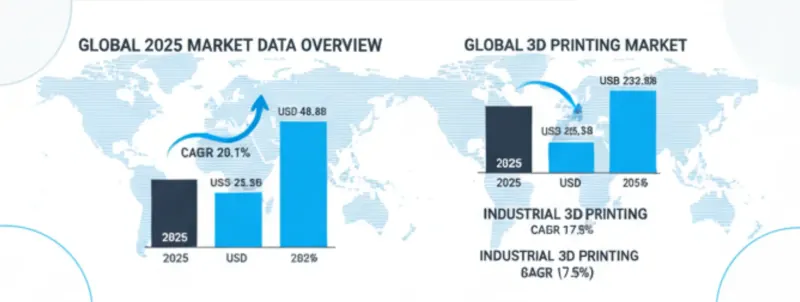
- The global 3D printing market is projected to grow strongly. According to Future Market Insights, it’s estimated to be USD 40.6 billion in 2025, and is forecast to reach USD 252.5 billion by 2035, at a CAGR of ~20.1% over that decade. Future Market Insights
- The industrial 3D printing segment (which would likely include large-format sign printers) is projected to reach USD 25.9 billion in 2025, with a 17.5% CAGR through 2035. Future Market Insights
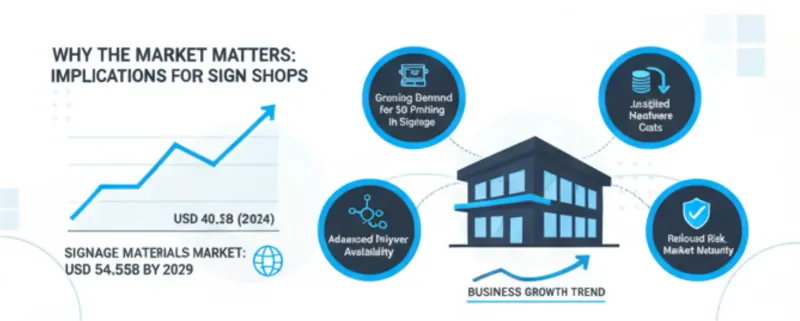
- On the signage side, the printed signage market is also growing: one report forecasts the printed signage market to be USD 41.6 billion in 2025, up from USD 40.2 billion in 2024. WiseGuy Reports
- For signage materials (including plastics, polymers, and other substrates), the printed signage materials market is expected to grow to USD 54.58 billion by 2029, driven in part by adoption of 3D printing in signage applications. PR Newswire
Implications for Sign Shops:
- The size and growth of both the 3D printing market and the printed signage market suggest growing demand and adoption potential.
- Rapid growth in 3D printing, especially industrial systems, means hardware costs could continue to fall, or at least become more justifiable as volume ramps.
- As materials for signage (especially advanced polymers) become more common, sign shops can more confidently adopt 3D-printed letters without compromising on quality or durability.
Projected ROI for a Sign Shop Investing in Large-Format 3D Printers
Let’s walk through a hypothetical ROI scenario for a sign shop.
Assumptions (these should be tailored based on real numbers, but here’s a sample model):
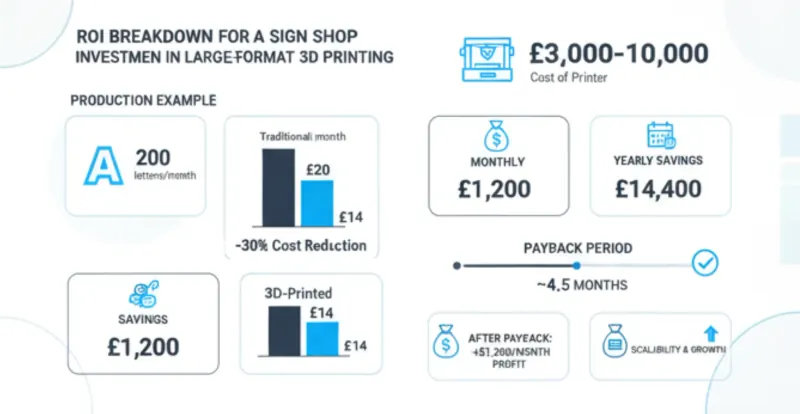
- CapEx: The shop buys one large-format sign 3D printer (e.g., a machine capable of printing full-size channel letters), costing, say, £3,000-£10,000 (or equivalent in local currency).
- Operating costs: Filament, electricity, maintenance, labour for supervision and post-processing. Assume moderate usage (e.g., nightly printing), but not full 24/7.
- Production volume: The shop produces, for example, 200 letters per month (average size), switching from traditional fabrication to 3D printing for some jobs.
- Cost savings: Based on the 30% cost reduction seen in the Tractus3D case, assume that each 3D-printed letter costs 30% less (labour + material) than when made traditionally.
- Revenue: The shop charges the same (or a small premium) for 3D-printed letters, because clients value the design flexibility or turnaround.
ROI estimation:
Monthly cost savings:
- Suppose traditional cost per letter is £20 (just an example). For 200 letters, that’s £4,000 cost.
- If 3D printing cuts cost by 30%, the cost becomes £14 per letter → total cost = £2,800 → saving of £1,200 per month.
Annualized savings:
- £1,200 × 12 = £14,400 saved per year (on those 200 letters per month).
Payback period:
- If the printer cost £5,000, the payback period = £5,000 / £14,4000 ≈ 0.35 years (less than 4,5 months).
Ongoing ROI:
- After payback, the shop benefits from the £1,200/month ongoing margin improvement, plus potential for further scale (more letters, more machines, less labour).
- In year 2 and 3, this could free up cash to reinvest (e.g., buy a second printer, hire more staff, or diversify into other 3D-printed signage products).
This is a simplified model – real ROI will depend on:
- The actual cost of the printer(s)
- The electricity and maintenance costs in your region
- The price you charge clients for 3D-printed letters
- The variation in job size (large vs small letters)
- How many hours per day/week the printer runs
But even with conservative assumptions, the ROI can be very attractive, especially for sign shops producing a moderate-to-high volume of channel letters.
Conclusion: Why Sign Shops Should Take Notice (Now)
- Market momentum is on your side: The overall 3D printing market is strong and growing, particularly in industrial segments. Meanwhile, the printed signage market continues to expand – even in a digital-first world.
- Financial case is compelling: With potential payback under 1 year (depending on setup), large-format 3D printers can generate real ROI for sign shops.
- Design and competitive advantage: With one-click design software (like Sign Group’s), shops can deliver creative, complex, custom signage more easily than ever.
- Scalability & flexibility: Digital production means consistency, easy scaling, and creative freedom that traditional fabrication struggles to match.
- Sustainability: Reduced scrap, efficient material use, and recyclable or long-lasting filaments make additive manufacturing more eco-friendly.
Final thought: For sign-making businesses ambitious enough to invest in future-facing technology, large-scale 3D-printed channel letters represent one of the most promising innovations. Between cost savings, design flexibility, and growing market adoption, the risk/reward balance is increasingly favourable.
It’s clear: large-format 3D printed channel letters are not just the future – they are the present.