How to Make Money with a 3D Printer in the UK: The 2026 Guide to Side Hustles, Etsy Sales & Starting Your Own 3D Printing Business
Published Updated
With cost-of-living pressures pushing more Brits toward side hustles, 3D printing has become one of the fastest-growing home-based businesses in the UK. From £20 phone holders on Etsy to industrial channel-letter signage worth thousands, this guide covers exactly what sells, what it costs, and how to start - legally and profitably.
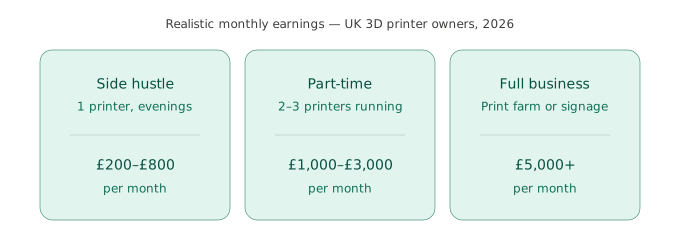
Quick answer: Yes, you can make money with a 3D printer in the UK. Realistic earnings in 2026 are:
- Side hustle (1 printer, evenings): £200–£800/month
- Part-time (2–3 printers): £1,000–£3,000/month
- Print farm or signage business: £5,000+/month
Profit margins typically run 40–60% on Etsy, rising to 70%+ in niches like replacement parts, custom jewellery, and illuminated signage. Startup cost: £350–£1,000 for a hobby setup; most break even in 2–6 months.
Introduction: Why 3D Printing Is Booming in the UK
Search interest in queries like "can you make money with a 3D printer UK" and "most profitable 3D prints to sell" has surged across 2025–2026, driven by tightening household budgets and the hunt for flexible, low-overhead income. The good news? The maths genuinely works. Real UK makers are reporting £500–£5,000+ per month with the right pricing strategy, and entry-level setups now start from as little as £350.
But there's a wide gap between hobbyists who lose money on every print and serious operators running profitable side hustles or full businesses. This guide closes that gap.
Can You Make Money with a 3D Printer in the UK?
The Short Answer: Yes - But Pricing Is Everything
3D printing is genuinely profitable in the UK in 2026, provided you price correctly and pick the right products. Industry data suggests typical Etsy sellers achieve 40–60% profit margins on handmade items, while niche categories like replacement parts, jewellery, and cosplay props can push margins into the 70% range. The most common reason new sellers fail isn't lack of demand - it's undercharging.
How to Actually Price a 3D Print: A Real UK Worked Example
We said undercharging is the number one reason 3D printing side hustles lose money. Here’s the proof – and a simple method to make sure you never do it.
The true cost of a print (the seven costs people forget)
New sellers look at a spool of filament, work out it costs about £1 of plastic to make an item, sell it for £12, and assume they’re pocketing £11. They’re not. Your real cost per item includes:
- Filament – by weight, not by spool. PLA works out at roughly £0.02 per gram at typical UK retail prices (about £18–22/kg).
- Electricity – a desktop FDM printer drawing ~120W costs around £0.03 per print hour at current UK rates (~27p/kWh).
- Failed prints – build a waste buffer in. Even a reliable machine has the odd failure; budget 5–10% on materials and time.
- Packaging – mailer, label, any padding. Often £0.50-£1.00 per order, and easy to forget.
- Platform & payment fees – on Etsy, listing, transaction and payment-processing fees come to roughly 10-11% of the sale price (more if you use Offsite Ads).
- Post-processing & finishing – support removal, sanding, assembly, QC.
- Your time – the cost everyone ignores. Design setup, personalisation, packing and customer messages are real labour. Put a number on your hour.
Worked example: a personalised desk nameplate
A popular, fast-selling Etsy product. Here’s the honest cost stack:
| Cost | Calculation | Amount |
|---|---|---|
| Filament | 60g × £0.02 | £1.20 |
| Electricity | 3 hr × £0.03 | £0.10 |
| Failed-print buffer | ~8% of materials + time | £0.15 |
| Packaging | Mailer + label | £0.60 |
| Your time | 15 min @ £12/hr (setup, finishing, packing) | £3.00 |
| True cost before fees | £5.05 |
Now price it at £14 and account for fees:
| Amount | |
|---|---|
| Sale price | £14.00 |
| Etsy + payment fees (~11%) | −£1.55 |
| True cost | −£5.05 |
| Net profit | £7.40 |
| Margin | ~53% |
That’s a healthy margin – squarely in the 40-60% range a sustainable side hustle should target. But notice the trap.
The mistake that wipes out your margin
If you’d priced that nameplate at £6 because “it only costs £1.20 of plastic,” your actual result after fees and real costs would be a loss – you’d be paying customers to take your work. This is precisely how busy-looking Etsy shops quietly run at a loss for months. The filament is the smallest cost on the list. Your time and the platform fees are what determine whether you have a business or an expensive hobby.
How batching changes the maths
The good news: per-unit economics improve sharply when you stop printing one item at a time. Fill the build plate, run jobs overnight, and your active time per unit collapses – the machine works while you sleep, and the only thing that scales linearly is filament and electricity, your two cheapest inputs. This is why serious side hustlers run 2-3 machines and batch identical orders: the time cost per item – the expensive part – drops with every unit on the plate.
A simple pricing formula
When you don’t want to model every item from scratch:
Selling price = total cost per item × 3 to 4
Total cost means everything above – materials, electricity, a failure buffer, packaging, fees and your time – not just filament. A 3-4× mark up typically lands you in that 40-60% net-margin zone after fees. For high-perceived-value items (personalised gifts, cosplay, custom signage) you can often go higher, because the buyer is paying for a unique, made-to-order product – not for raw plastic.
Rule of thumb: if you’re only making a couple of pounds per sale, you’re running a hobby, not a side hustle. Price for the value you deliver and the time you put in – then reinvest the margin into faster, more reliable machines so you can batch and scale.
How Much Can UK 3D Printer Owners Realistically Earn?
Earnings vary wildly by setup and effort, but rough benchmarks look like this:
– Casual side hustle (1 printer, evenings/weekends): £200–£800/month
– Serious part-time operation (2–3 printers): £1,000–£3,000/month
– Print farm or commercial signage business: £5,000+/month
– Operators running multiple machines or industrial-grade equipment – for example, channel-letter, built up letters signage businesses using automated commercial 3D printers – can scale dramatically because one person can manage up to ten machines simultaneously with modern automated systems.
What Makes 3D Printing Profitable in 2026?
Low Barriers to Entry
A starter setup (printer, filament, basic tools, a free Etsy shop) costs roughly £350–£1,000. Most well-run businesses break even within 2–6 months.
High-Margin, Low-Cost Products
A typical desk organiser uses about £0.80 of PLA filament and sells for £15–£25. A custom phone holder costs pence to print and retails at £8–£15. The maths is forgiving when material costs stay low and markup is reasonable.
Customisation as Your Competitive Edge
You can't compete with Amazon on mass-produced items - but you can offer personalisation, small batches, and quick turnaround that big retailers physically can't.
What 3D Prints Sell Best on Etsy?
Etsy remains the single best platform for UK 3D printing side hustles thanks to its premium, gift-focused audience. Buyers there expect to pay more for unique, customised items, which means higher margins than eBay or Amazon Handmade.
The Top-Selling Categories on Etsy in 2026
Functional Home & Office Items
Drawer dividers, cable organisers, headphone stands, pen holders, and desk accessories. These print fast (often under 2 hours), ship light, and solve everyday annoyances. Buyers commonly purchase multiple units per order, lifting average order value.
Custom & Personalised Designs
Name keychains, nameplates, custom cookie cutters with logos, and personalised lithophones (photos that reveal themselves under light) consistently outperform generic items. Personalisation increases perceived value and repeat purchases.
Cosplay Props and Tabletop Gaming
Sword pommels, helmet sections, miniatures, and tabletop terrain. These communities are passionate and willing to pay premium prices - often £30–£200+ per piece.
Lithophanes and Photo-Based Gifts
A standout 2025–2026 trend. Low filament cost, high emotional value, ideal for Mother's Day, Father's Day, anniversaries, and pet memorials.
Etsy's 2025 Policy Update — What UK Sellers Need to Know
In June 2025, Etsy tightened its rules: 3D prints must come from your own original designs. Direct STL downloads and remix files no longer comply, and listings can be removed. UK sellers should design originals or licence commercial-use STLs from platforms like MyMiniFactory or Cults3D.
Most Profitable 3D Prints to Sell
If you only build product lines around the items below, you'll be aligned with what's actually selling in the UK right now.
Phone Holders and Stands
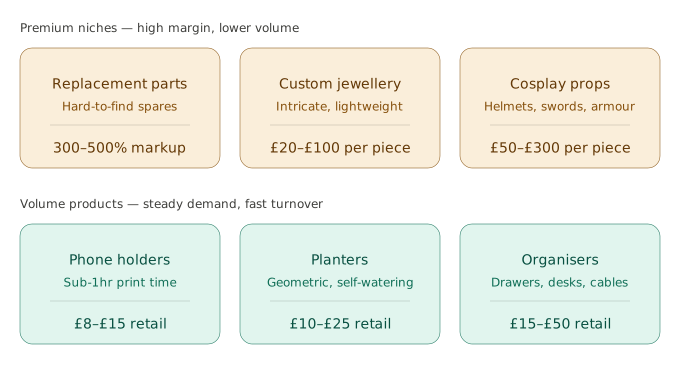
Adjustable, foldable, magnetic - endless variations. Sub-1-hour print times and £8–£15 retail prices make this a workhorse SKU.
Planters and Garden Decor
Geometric planters, self-watering pots, and wall-mounted herb holders are huge on Etsy and Pinterest. Excellent for buyers redecorating on a budget.
Desk and Drawer Organisers
Modular dividers, cable trays, and bathroom drawer inserts. Bundle them for higher order values (£25–£50 per set).
Cosplay Props and LARP Gear
The highest-margin physical product category for skilled printers. Helmets, gauntlets, and weapons retail for £50–£300+.
Vases and Decorative Pieces
"Vase mode" prints are fast, dramatic, and use minimal filament. Excellent margins for the print time.
iPhone Cases and Tech Accessories
Lightweight, cheap to ship, and fashion buyers love novelty designs. Fit precision matters - invest in dimensional accuracy.
Premium Niches: Where Margins Hit 70%+
Replacement Parts
Discontinued appliance parts (washing-machine knobs, vacuum clips, furniture feet) sell for 300–500% markup because buyers have nowhere else to find them. The "right to repair" movement has supercharged this niche.
Custom Jewellery
Lightweight, intricate, hard to mass-produce - buyers happily pay premium prices for one-of-a-kind earrings, pendants, and bracelets.
Illuminated 3D Signage and Built Up Letters
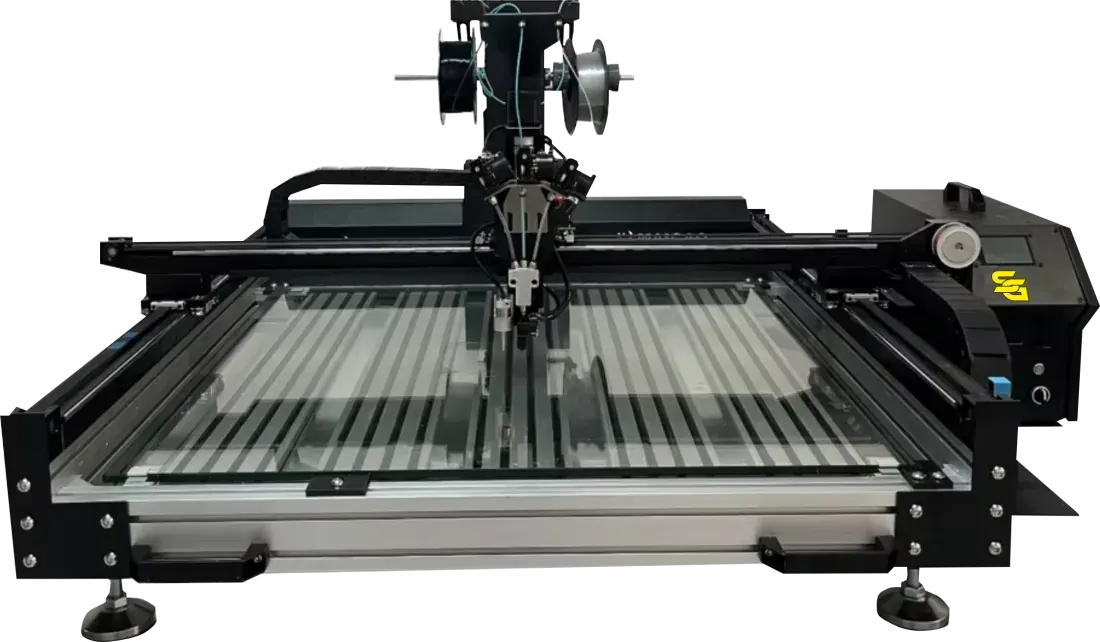
The high-ticket end of the market. Custom illuminated signs for shops, restaurants, and events sell for hundreds to thousands of pounds per piece. This is where industrial-grade UK equipment from suppliers like SG 3D Printers (London) comes in - their built up letter printers (SG-S 3D Ultra and SG-S 3D Pro Ultra) are purpose-built for sign-makers and visual communications companies, producing front-lit, side-lit, RGB, and infinity-mirror 3D letters at production speed.
How to Start a 3D Printing Business in the UK
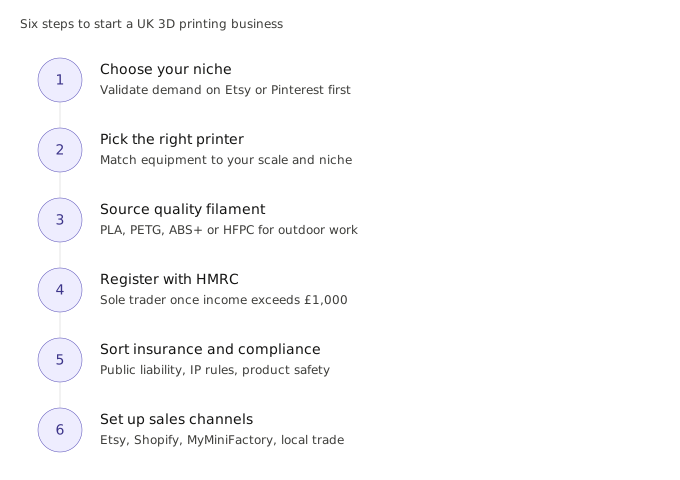
Step 1: Choose Your Niche
Don't try to sell everything. Pick one category - say, organisers, cosplay, or signage - and dominate it. Use Google Trends, Pinterest Trends, and Etsy search volume to validate demand before buying equipment.
Step 2: Pick the Right 3D Printer
Entry-Level FDM Printers
Mid-Range Production Printers
£500–£2,000. Faster speeds, larger build volumes, better reliability. The sweet spot for serious side hustlers running 2–3 machines.
Industrial-Grade UK Printers (for Sign Shops & High-Ticket Niches)
If your goal is the commercial signage market, a hobby printer won't cut it. UK-based SG 3D Printers manufactures channel-letter machines designed for trade use, with features specifically aimed at running a profitable signage business:
- Energy-efficient operation - only 1–2 kWh consumed across 24 hours of work
- Fully automated - one-button operation with integrated touchscreen, no operator needed during the run
- Build sizes of 800×800mm or 1200×1200mmBuilt-in UV curing for liquid acrylic faces (UV models)
- Multi-format output - 3D-printed face, liquid acrylic, sheet acrylic, and infinity mirror
- One-click 3D file generation software - no 3D modelling skills required
- UK assembly, on-site UK training, locally available spare parts, and a 2-year warranty
- For a sign-maker or visual communications business, this category turns 3D printing from a side hustle into a scalable production operation.
Step 3: Source Quality Filaments
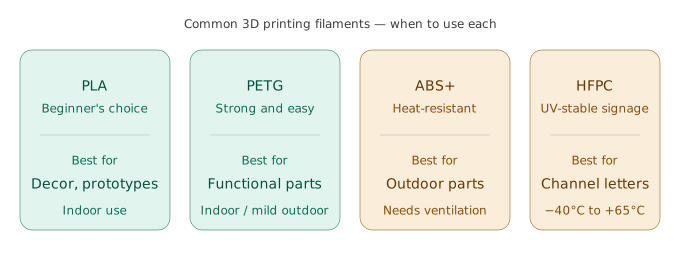
Filament choice directly affects print quality, durability, and what you can charge. Common options stocked by UK suppliers including SG 3D Printers:
PLA (Polylactic Acid)
Beginner-friendly, prints at lower temperatures, no heated bed required. Biodegradable (made from corn starch / sugarcane), low odour, less prone to warping. Ideal for prototyping, decor, and general indoor items - though not the strongest material for outdoor or load-bearing parts.
PETG
The "best of both worlds" - easy to print like PLA, strong like ABS, often food-safe, no harmful fumes. Hygroscopic (absorbs moisture), so storage matters.
ABS+
Stronger and more heat-resistant than PLA, but harder to print (needs a heated bed and ventilation). Excellent for functional parts, automotive items, and outdoor sculptures when properly treated.
HFPC (High Flexible Polymer Composite)
A specialist filament from SG 3D Printers engineered specifically for outdoor illuminated signage. Modified polycarbonate + PETG blend with UV resistance, operating range of −40°C to +65°C, excellent light transmission for backlit signs, and strong adhesion to liquid acrylic. If you're entering the signage niche, this is the material that lets you charge premium prices for commercial-grade durability.
Why a Filament Dryer Matters
PLA, PETG, ABS, Nylon, and TPU are all hygroscopic. Even a few hours in damp UK air causes stringing, brittle prints, weak layer adhesion, and inconsistent extrusion - all of which destroy margins through failed prints. A dedicated filament dryer (SG 3D Printers and other suppliers stock industrial models) is one of the cheapest upgrades that directly improves print success rates and product quality.
Step 4: Register Your Business with HMRC
Once your 3D printing income exceeds £1,000 in a tax year, you're legally required to register with HMRC. The two main structures:
Sole Trader (Recommended for Most Side Hustlers)
- Free to register via the HMRC Government Gateway
- You receive a Unique Taxpayer Reference (UTR) within ~10 working days
- Submit a Self Assessment tax return annually (deadline 31 January)
- Personal allowance: first £12,570 tax-free; 20% basic rate to £50,270; 40% to £125,140
- Downside: unlimited personal liability
Limited Company
- Registered with Companies House
- Better liability protection and a more professional appearance to commercial clients
- More admin and accountancy costs
VAT Registration
Mandatory once your taxable turnover exceeds £90,000 in any 12-month period. Voluntary registration below the threshold can be useful if you want to reclaim VAT on equipment purchases (relevant if you're buying an industrial-grade printer).
Step 5: Sort Out Insurance & Compliance
- Public liability insurance - essential if customers visit your workspace or collect items
- Professional indemnity insurance - recommended if you offer design services
- Product safety compliance - extra rules apply for items intended for children, food contact, or medical use; ensure UK product safety standards are met
- IP protection - never sell prints based on trademarked or copyrighted designs (Disney, Marvel, sports logos, etc.) without a licence; respect "personal use only" terms on downloaded STLs
Step 6: Set Up Your Sales Channels
- Etsy - best for premium, customisable consumer goods
- Amazon Handmade - broader reach, tighter margins
- Shopify / your own site - best for brand-building and direct B2B
- MyMiniFactory / Cults3D / Printables - sell STL design files for passive income (24/7 sales without printing anything)
- Local channels - sign shops, schools, makerspaces, and small businesses for prototyping and bespoke commissions
Frequently Asked Questions (Q&A)
Q: Can you make money with a 3D printer in the UK?
A: Yes. UK makers typically earn £500–£5,000+ per month with proper pricing. Profit margins of 40–60% are standard on Etsy, and 70%+ is achievable in niches like replacement parts, custom jewellery, and commercial signage. The most common cause of failure is undercharging, not lack of demand.
Q: What 3D prints sell best on Etsy in 2026?
A: Functional home and desk organisers, custom name keychains, personalised lithophanes, cosplay props, planters, vases, phone stands, and iPhone cases consistently top Etsy bestseller lists. Personalised and customisable items command the highest margins because buyers can't find them elsewhere.
Q: How much does it cost to start a 3D printing business in the UK?
A: A starter setup runs £350–£1,000 (entry-level printer £150–£300, filament £50–£100, tools £50–£100, marketing £100–£500). A serious mid-range setup is £500–£2,000. Industrial channel-letter printers for sign shops are a separate investment tier - but they unlock a much larger commercial market.
Q: Do I need to register with HMRC for a 3D printing side hustle?
A: Yes - as soon as your self-employed income exceeds £1,000 in a tax year. Most side hustlers register as sole traders (free, online, takes about 10 working days for your UTR). VAT registration becomes mandatory above £90,000 turnover.
Q: What are the most profitable 3D prints to sell?
A: By margin: replacement parts (300–500% markup), custom jewellery, illuminated 3D signage, cosplay props, and lithophanes. By volume: phone holders, organisers, planters, vases, and iPhone cases. Most successful UK sellers combine high-volume "workhorse" SKUs with one or two premium products.
Q: Why is filament moisture such a big deal for selling 3D prints?
A: Common filaments (PLA, PETG, ABS, Nylon, TPU) absorb moisture from UK air within hours, causing stringing, weak layer adhesion, brittle parts, and visible defects. Failed prints destroy margins. A dedicated filament dryer is one of the cheapest, highest-ROI upgrades for any 3D printing business.
Q: Should I scale up from a hobby printer to industrial 3D printing?
A: Only if you're targeting a high-ticket niche where the volume justifies it - commercial signage, retail displays, architectural models, or large-format custom work. UK-based suppliers like SG 3D Printers offer fully automated channel-letter machines with one-click software, built-in UV curing, energy-efficient operation, and UK-based training and support. For sign-makers and visual communications companies, this is where 3D printing crosses from side hustle into scalable production business.
Q: Can I sell 3D prints based on Disney or Marvel characters?
A: No - not without a licence. Trademarked logos and character IP are off-limits. Stick to your own original designs or commercially licensed STL files. Etsy actively removes infringing listings under its 2025 policy update.
Final Thoughts: Is 3D Printing the Right UK Side Hustle for You?
3D printing rewards the disciplined more than the lucky. Pick a niche, validate demand before buying equipment, price for at least 50% margins, and treat your shop like a business - register with HMRC, keep clean records, and reinvest profits into faster machines or better filaments.
For most UK readers, an entry-level FDM printer + an Etsy shop selling organisers, planters, or personalised gifts is the right starting point. For those targeting the commercial sign-making and visual communications market, an industrial UK-assembled channel-letter printer paired with HFPC outdoor-grade filament is the path to a higher-ticket, more defensible business.
Either way: start small, ship consistently, and scale once your numbers tell you to.
About SG 3D Printers SG 3D Printers is a UK-based supplier of industrial channel-letter 3D printers, sculpture printers, accessories, and signage filaments - all assembled in the UK with on-site training, locally available spare parts, and a 2-year warranty. Based at 17 Burnt Oak Broadway, London HA8 5LD. Tel: +44 203 620 1605. Visit sg3dprinters.com for product details and the company's blog.