How to Choose 3D Printer Filament: 2026 UK Guide
Published Updated
Choosing the right 3d printer filament can make or break your print. The “best” filament depends on what you intend to use the print for: Is it a prototype, a decorative model, a mechanical part, a functional outdoor sign, or lighted channel letters?
Before diving into specific materials, let’s cover basic criteria you should evaluate:
| Criterion | Why it matters | Useful benchmarks / remarks |
|---|---|---|
| Printability / ease of use | Some filaments are forgiving; others demand tight tolerances, heating, and enclosed setups | Low-warp, low-odour, consistent extrusion |
| Mechanical properties | Strength, toughness, flexibility, impact resistance | Tensile strength, elongation at break, layer adhesion |
| Thermal / heat resistance | Some parts need to survive heat or sun exposure | Glass transition, deformation under load |
| Chemical / UV / weather resistance | For outdoor / exposed use | Resistance to UV, moisture, oxidation |
| Dimensional stability / warping | To maintain shape and tolerances | Low shrinkage, low warping, good bed adhesion |
| Aesthetic / optical properties | Surface finish, clarity, light diffusion, translucency | Matte vs glossy, transparent, diffusion for lighting |
| Cost, availability, and storage | Even the best technically ideal filament might not be practical | Price per kg, spool consistency, moisture sensitivity |
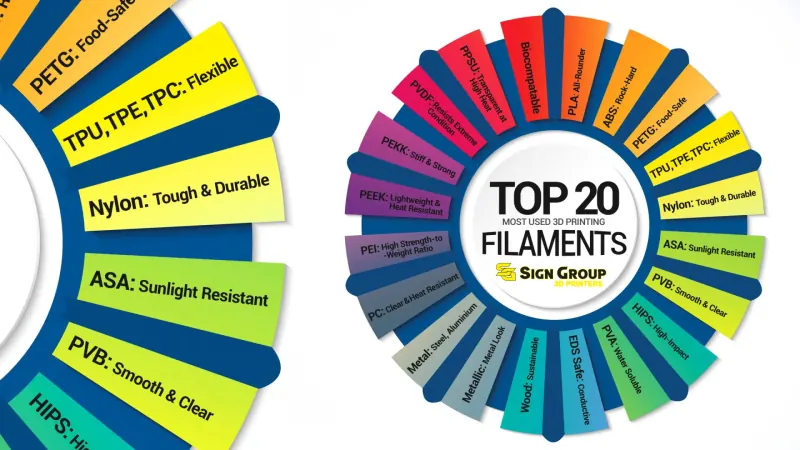
From the Baruch MakerHub blog, some of the most commonly used 3D printer filament are PLA, ABS, PETG, TPU.
They note that PLA is easiest to print, ABS is tougher and more heat resistant, PETG offers a middle ground (ease of print + durability), and TPU gives flexibility.
From the Sign Group / 3D Printers site, there’s a specialized material they call HFPC (High Flexible Polymer Composite), designed for signage and channel letters.
In the sections below, we’ll look at filament choice in normal / general-purpose 3D printing first, then pivot to channel letters / signage printing with its peculiar demands.
3D printer filament Options for “Normal” 3D Printing
By “normal 3D printing,” I mean desktop FDM / FFF machines printing models, parts, prototypes, jigs, etc. Here are the major contenders and when to choose them:
PLA (Polylactic Acid)
Pros:
- Very easy to print (lower temperatures, less warping)
- Large colour / filament variety
- Biodegradable (in industrial composting settings)
- Good for prototyping, decorative items, non-structural parts
Cons:
- Low heat tolerance (softens at ~ 55–65 °C)
- Brittle compared to some engineering plastics
- Not ideal outdoors (UV, moisture)
When to use PLA:
- For quick prototypes, visual models, low-stress parts
- In a well-controlled indoor environment
- When you want the easiest “first try” success
ABS (Acrylonitrile Butadiene Styrene)
Pros:
- Better impact resistance
- Higher temperature resistance than PLA
- More durable parts
Cons:
- More warping, needs heated bed and ideally an enclosure
- Emits fumes / odours, needs ventilation
- Harder to get good layer adhesion
When to use ABS:
- For parts that must absorb shock or live in somewhat hotter environments
- When you have a controlled printer (heated bed, enclosure)
PETG (Glycol-modified PET)
Pros:
- Easier to print than ABS (less warping)
- Stronger and more temperature resistant than PLA
- Good chemical resistance
- Transparent / translucent variants possible
Cons:
- Slight stringing or oozing issues
- Moisture sensitivity (hygroscopic)
- Surface finish sometimes less crisp
When PETG is ideal:
- For functional parts with moderate heat / stress
- When you want something more robust but still relatively easy to print
TPU / Flexible Filaments
Pros:
- Excellent flexibility, elasticity
- Good for shock absorption, gaskets, wearable items
Cons:
- Harder to feed (you need proper extruder setup)
- Lower rigidity — not suitable for structural parts
When to use TPU:
- For flexible parts (belts, seals, grips)
- Specialty items needing bend / shock resilience
Other Engineering / Advanced 3d printer Filaments
- Nylon: strong, durable, somewhat flexible, but very moisture sensitive
- Polycarbonate (PC): high heat resistance, strong — requires high-temperature extruder and often enclosure
- ASA / ABS-like UV resistant: better outdoors than ABS
- Composites / fibre-reinforced: carbon fibre, glass fibre — for strength / rigidity (but more abrasive)
Matching Filament to Desired Outcomes (with Comparisons)
Here’s a cheat sheet of what filament to pick for specific use cases:
| Use Case | Priority | Suggested Filament(s) | Notes / trade-offs |
|---|---|---|---|
| Visual prototypes, concept models | Ease, colour variety, low cost | PLA | Very forgiving; but limited for functional load or heat |
| Mechanical parts, robotics, brackets | Strength, good layer adhesion | PETG, ABS, Nylon | PETG often offers best balance; ABS needs more control |
| Outdoor / UV-exposed parts | UV / weather / heat resistance | ASA, ABS+, PC | More demanding to print (temperature, enclosure) |
| Parts experiencing bending or flex | Elasticity, fatigue resistance | TPU, flexible blends | Requires specialized printer setup, careful tuning |
| High-temperature / structural parts | Heat resistance, rigidity | PC, high-temp composites | Use with high-temperature hot end, heated chamber |
| Transparent / light-transmissive parts | Clarity, diffusion | Clear PETG, special optical filaments | Manage layer visibility, polish, post-process |
In practice, many users default to PLA or PETG for general use, because they minimize failed prints and frustration.
One caution: Moisture is a common enemy. Many filaments (PETG, Nylon, TPU) are hygroscopic—they absorb moisture from air, which degrades print quality (bubbling, stringing, weak layers).
The Sign Group site emphasizes using filament dryers especially when working with sensitive filaments.
Special Case: Channel Letters / 3D Signage Printing
Printing channel letters (the kind used for illuminated signage) puts additional constraints — not just “good enough,” but optical properties, weather durability, diffusion of light, and long-term exposure.
From the Sign Group site:
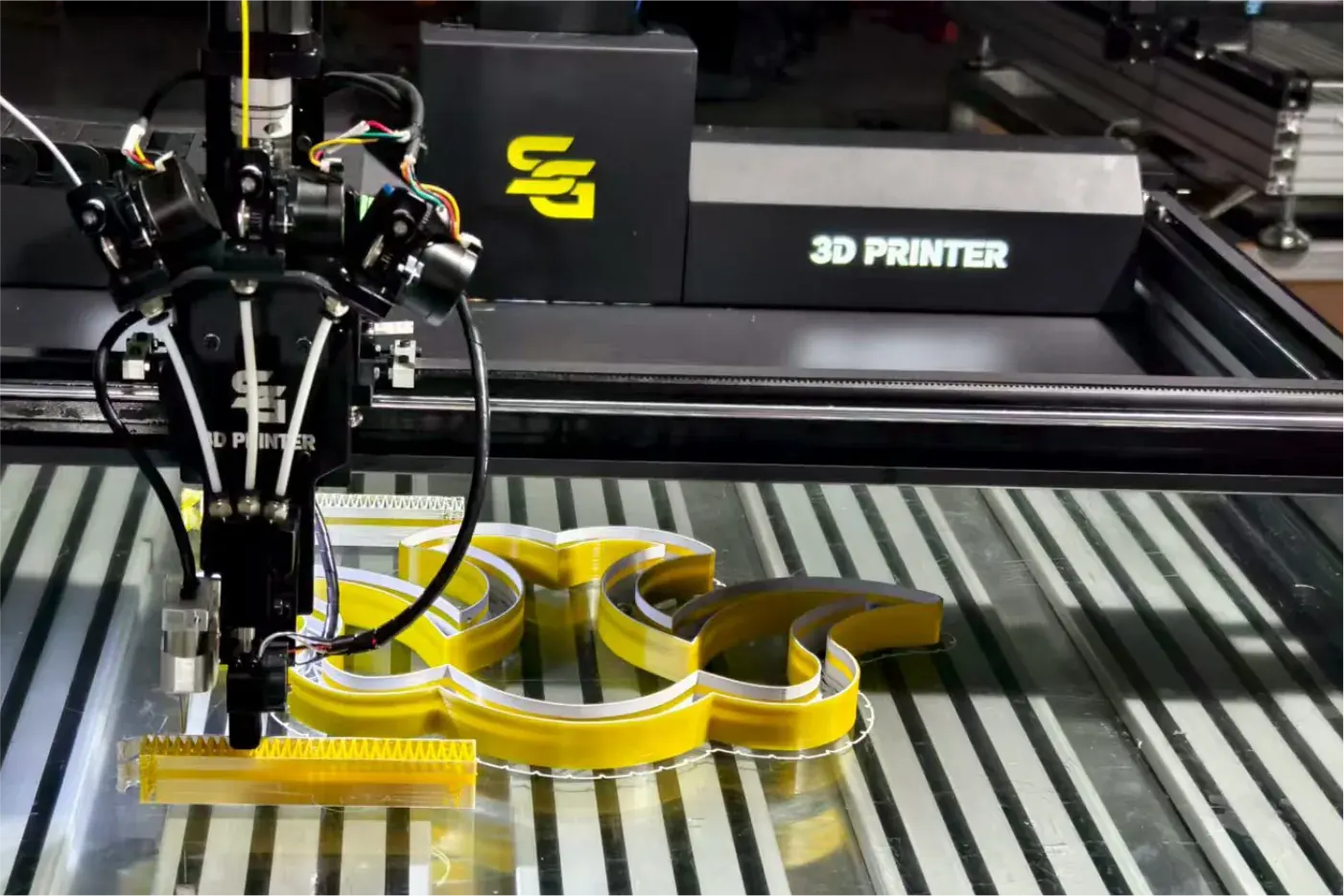
- Their printers are targeted for channel letter geometric fabrication.
- They list HFPC (High Flexible Polymer Composite) as a filament especially engineered for signage. According to them, HFPC combines modified polycarbonate (PC) + PETG + additives. It offers optical clarity / uniform diffusion, weather / UV resistance, temperature range from –40 °C to 65 °C, and good adhesion to liquid acrylic adhesives.
- The site also mentions regular materials such as PLA, ABS+, and PETG as available for signage work, but with their typical trade-offs.
Given this, here’s how to think about filament choice for signage:
Key requirements for channel letters
- Light diffusion / optical clarity: You want a material that doesn’t give uneven patches or visible seams when lit from behind or within.
- UV / weather resistance: The letters will face sun, rain, temperature swings, possibly pollution.
- Bonding / assembly: It must be compatible with adhesives (e.g. for acrylic faces) or coatings.
- Dimensional stability: Warping or deformation over time ruins alignment or even lighting effects.
- Printability at relatively large scale: Some letters are large; filament must remain consistent across long runs.
- Thermal tolerance: The internal lighting (LEDs) can produce heat; external sun can warm the letters.
Comparing 3d printer filament options in the signage context:
- PLA: While easy to print, it’s weak outdoors (warps, shows discoloration) and may degrade under UV. Usually more suitable for indoor mock-ups or non-illuminated decorative signage.
- ABS / ABS+: Better mechanical strength and thermal resistance, but still vulnerable to UV and warping. Requires enclosure and careful printing. Could be used with protective coatings.
- PETG: Decent candidate — more UV-stable than plain PLA, somewhat easier to print than ABS. However, its clarity and diffusion must be managed, and moisture sensitivity remains a concern.
- HFPC (Sign Group’s specialized composite): Designed for the job. Its properties are tailored for signage (UV, optical diffusion, ability to bond) — likely the best pick for serious channel letters work using that printer ecosystem.
- Other advanced materials: Transparent/acrylic-grade films, coated PC, or optical resins (if the printer allows) might be used for specific use cases (e.g. front faces, light diffusers) in combination with structural parts in HFPC or PETG.
In short: for channel letters, you’ll often choose a hybrid / specialty filament (like HFPC) as your primary material, with supporting materials (e.g. acrylic, coatings) to handle the front face or finishing.
Also, due to moisture and print consistency, using a filament dryer or tightly controlled humidity is especially critical. Sign Group highlights the necessity of dryers for high-quality prints.
How to Select Filament — Step-by-Step Guide
Here’s a decision path you can follow when picking filament for a project:
Define the project parameters
- Indoor vs outdoor?
- Mechanical load?
- Size / dimensions?
- Optical / aesthetic requirements?
- Lifespan / exposure expectations?
- Filter by required properties
E.g. if outdoor, eliminate PLA; if exposed to heat, eliminate weak materials. Check printer compatibility / capability
- Maximum nozzle temp
- Heated bed / enclosure
- Extruder type (direct, Bowden)
- Filament dryness / moisture control
- Shortlist candidate filaments
(e.g. PETG, ASA, HFPC) - Test small parts / test prints
Especially for optical / diffusion performance, adhesion, warping. - Evaluate bonding, finishing, post-processing
Does the material accept paint, adhesives, coatings, smoothing? - Consider cost and supply / storage
Ensure reliable sourcing, proper storage (dry boxes), spool quality.
Example Scenarios
Here are a few example scenarios to illustrate:
- Prototype housing for an electronic device (indoor use) → PLA (ease, low cost)
- Functional bracket in a workshop, mild heat / humidity → PETG
- Outdoor signage display (no internal light) → ASA or PETG with UV-resistant coating
- Channel letter for storefront, illuminated at night → HFPC (or a blend of PETG/PC hybrid) with good diffusion
- Glowing / light-diffusing face plate insert → Clear PETG or optical filament, polished / post-processed
Tips & Best Practices
- Dry filaments before printing, especially hygroscopic ones (PETG, Nylon)
- Use proper bed adhesion and enclosure when needed
- Optimize cooling / layer times to balance clarity and surface finish
- Use test coupons to check clarity, diffusion, and light bleed before doing full build
- Maintain consistent printing conditions (temp, humidity, airflow)
- Use protective post-coats / UV stabilisers for outdoor parts
- Monitor spool quality / diameter consistency
Conclusion
Choosing the best filament is not a one-size-fits-all decision — it’s about matching material properties with project constraints and printer capabilities.
For ordinary printing, PLA, PETG, ABS and TPU cover a wide range of use cases, each with trade-offs.
For channel letters and signage, optical performance, weather durability, and diffusion are additional critical factors, pushing you toward specialized filaments like HFPC that blend mechanical and optical performance.